


A Selection of our Past Events
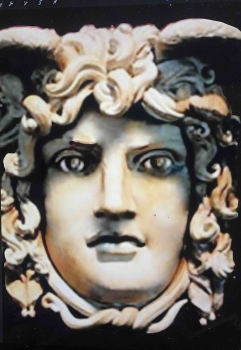
METAMORPHOSES
by OVID
HUGH LUPTON and DANIEL MORDEN
Sunday 24 March 2024 at 8pm
PLEASE NOTE LATE START TIME
THE DOORS WILL OPEN AT 6.30pm FOR REFRESHMENTS BEFORE THE PERFORMANCE at 8pm.
LATE COMERS CANNOT BE ADMITTED.
TICKETS ARE AVAILABLE via EVENTBRITE
OR ON THE DOOR
9 CLARENDON CROSS W11 4AP
Nearst tube Holland Park Avenue
Tel enquiries only: 07887 506848
Narrated by HUGH LUPTON and DANIEL MORDEN
An evening of tales of transformation, featuring many of the most popular stories from the Classical World: Arachne, Orpheus in the Underworld, Echo and Narcissus, Demeter and Persephone, Midas, Baucis and Philemon….
Ovid’s ‘Metamorphoses’ has enchanted audiences and inspired artists for more than two thousand years. These retellings enable them to charm and chill us still today.
“The tale… stopped all our hearts, however hardened by age.” The Guardian
Hugh Lupton is a master of poetic storytelling, with a distinctive style focusing on richly crafted use of the English language. An award-winning performer and writer, Lupton has collaborated widely with singers, musicians and other performers. In 2005, he won the Classical Association prize for 'the most significant contribution to the public understanding of the classics' with Daniel Morden. His first novel, based on the life of the poet John Clare, was published in 2010 and his song One in a Million (co-written with Chris Wood) won the BBC Two folk awards for 'Original Song of the Year' in 2005.
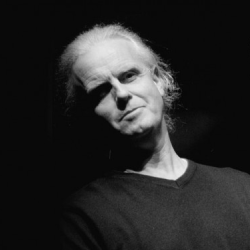
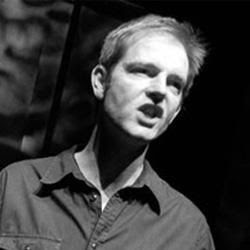
Daniel Morden is one of the UK's most popular storytellers and member of the acclaimed Devil's Violin Company. For 23 years he has delighted audiences all over the world at storytelling festivals including those in Vancouver, Oslo and the Yukon. In London he has performed at venues from the Barbican and National Theatre to the British Museum. An award-winning storyteller, Morden has also worked on TV and radio and published books for both children and adults.
WE LOOK FORWARD TO WELCOMING YOU TO THIS SPECIAL EVENT
Quatuor pour la Fin du Temps
by Olivier Messiaen
A concert by Zimro
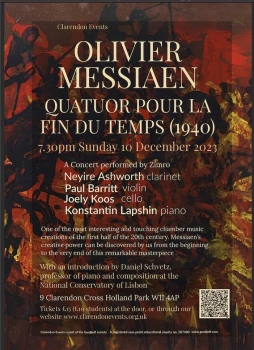
Sunday 10 December 2023 at 7.30pm
ZIMRO
Neyire Ashworth clarinet
Paul Barritt violin
Joely Koos cello
Konstantin Lapshin piano
With an introduction by Daniel Schvetz, professor of piano and composition at the National Conservatory of Lisbon.
A remarkable work of art, without doubt one of the most interesting and touching chamber music creations of the first half of the XXth century, with an original and peculiar combination of instruments, but extremely curious due to its form and timbre combinations.
The inspiration came from multiple sources, beginning with the Book of Revelations/The Apocalypse, which resonated deeply and sincerely with Olivier Messiaen’s profound religious feelings and beliefs. Each of its eight parts, or musical scenes, is endowed with a suggestive and mystical title, “Liturgie du Cristal”, “Louange a l’eternitée du Jesus” etc, and came from someone who conceived and created this work while in captivity in a German prisoner of war between 1940 and 1941. Amidst the crosscurrents of war time and religion, without any hesitation, his creative power can be found and discovered by us from the beginning to the very end of this incredible masterpiece of chamber music.
Tickets £15 (£10) at the door or on Eventbrite
ZEN (2009) The Life of Zen Master Dogen
A dramatised film of his life
120 minutes, in Japanese with English subtitles

Sunday 12 November 2023 at 7pm
Dogen was a famous Japanese monk who founded the Soto school of Zazen in the 13th century. His extraordinary life is sincerely and accurately told in this beautiful and moving film.
Reception with refreshements for all afterwards
Tickets are available on the door and at Eventbrite
ZEN BUDDHISM IN JAPANr
A note from Nobuko Hirose:
Zen played an important role in forming Japanese culture and character.
“Zen is a religion with a unique method of body and mind training the aim of which is satori, that is, self realisation”
All Buddhist schools teach enlightenment which is their central point, however, in the case of Zen Buddhism one has to seek enlightenment by one's own effort and discipline.
What is enlightenment? According to D T Suzuki it means emancipation. Real freedom is the outcome of enlightenment.
In the early 6th century the patriarch Bodidharma first introduced meditation (dhyana in Sanskri) Buddhism to China from India. This form of Buddhism is known as Ch’an in China and Zen in Japan. In the 12th century it was brought to Japan from China.
Eisai (1141-1215) founded Rinzai Zen (sudden enlightenment). One of the methods for this training is Koan.
In the 13th century Dogen (1200-1253) founded Soto Zen (gradual enlightenment) at a Eihei Ji temple in Fukui. Shikantaza (just sit for meditation, is itself satori – self realisation).
Those two schools (Rinzai Zen, sudden enlightenment and Shikantaza, gradual enlightenment) are the main Zen Buddhist schools in Japan.
THE MAHABHARATA
A FIVE AND A HALF HOUR FILM BY PETER BROOK 1969
Live movie projection
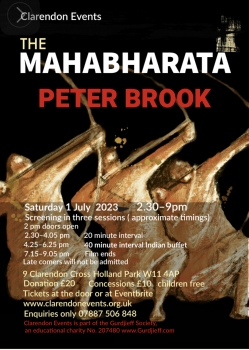
Saturday 1 July 2023 at 2.30PM
TICKETS AT THE DOOR OR IN ADVANCE here
CARDS ARE ACCEPTED (new)
CHILDREN FREE
COME AND JOIN US FOR A UNIQUE EXPERIENCE SHARING THIS UNIQUE AND GRIPPING FILM OF ONE OF THE GREAT ANCIENT EPIC STORIES OF MANKIND.
THERE WILL BE TWO INTERVALS, DURING THE SECOND LONGER INTERVAL DELICIOUS INDIAN FOOD WILL BE SERVED (included) WITH DRINKS.
IN FRONT OF THIS FILM TIME WILL STAND STILL.
WE LOOK FORWARD TO WELCOMING YOU.
The Mahabharata is a 1989 film version of the Hindu epic Mahabharata directed by Peter Brook. Brook's original 1985 stage play was 9 hours long, and toured around the world for four years. In 1989, it was reduced to under 6 hours for television (TV mini series). Later it was also reduced to about 3 hours for theatrical and DVD release. The screenplay was the result of eight years' work by Peter Brook, Jean-Claude Carrière and Marie-Hélène Estienne.
In general terms, the story involves epic incidents between two warring families, the Pandavas (representing the good side) and the Kauravas (representing the evil side). Both sides, being the offspring of kings and gods, fight for dominion. They have both been advised by the god Krishna to live in harmony and abstain from the bloody lust for power. Yet their fights come to threaten the very order of the Universe. The plot is framed by a dialogue between the Brahmin sage Vyasa and the Hindu deity Ganesha, and directed towards an unnamed Indian boy who comes to him inquiring about the story of the human race.
Here is the schedule of o?ur screening at 9 Clarendon Cross>
2.00pm Doors open
2.30pm Film starts 1st part
4.05pm Break
4.25 Film 2nd part
6.25 Break for Indian food (included)
7.15 Film 3rd part
9.05pm Film ends
All timings are approximate
Late comers will not be admitted.
Film trailer (no German subtitles)
Tickets at the door or in advance here
enquiries@clarendonevents.org.uk
Tel Enquireis only 07887 506848
THE MUSIC OF A MASTER
A concert of music by G I Gurdjieff and Thomas de Hartmann performed by members of the Gurdjieff Society of Paris and London
Herbert Lashner - oboe, Dietrich Bethge - cello, John Quitzke - percussion, Corinne Cordier - piano
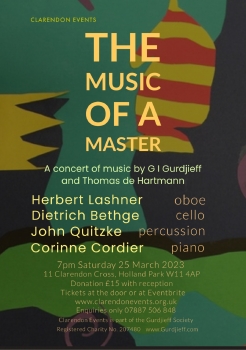
Saturday 25 March 2023 at 7 pm
Music – ancient Afghan, Armenian, Kurdish and Greek chants, dances, prayers and songs
Musicians – Herbert Lashner, John Quitze and Corinne Cordier from Paris and Dietrich Bethge from London come together to give a performance
of music composed by Mr Gurdjieff and written down by the composer Thomas de Hartmann. These haunting melodies and otherworldly harmonies are rarely heard live.
The concert – will last about one hour (without an interval) and will be followed by a wine reception (included in the suggested donation of £15).
FACING THE UNKNOWN
Contemporary Physics and Traditional Teachings
Dr. Jean Pian
Sunday 26 February 2023 at 7pm
Modern Physics and Traditions Facing the Unknown
One aim of the talk is to awaken the audience to the fact that we do not know what we are, not only from a psychological point of view but also more essentially as a form of Life.
Contemporary physics teaches us that Reality is not at all what we believe it to be, that it
is not possible to describe it or to represent it by means of our ordinary concepts.
The shock of this discovery can awaken (initiate) a silence and help to place us in front of the unknown of what we are and of what surrounds us.
"Nothing is as we see it..." words of a spiritual master? Or of scientific researchers?
This talk does not require any scientific prerequisite. The purpose is not to explain certain phenomena discovered by modern physics. It would be impossible. Any explanation would require a substantial knowledge of mathematics and physics.
Modern physics/versus technology and scientism
A few quotations ..
« ..physicists do not aim at technical progress, which occurs only "by the way" so to speak. I repeat, they seek above all that evanescent but so precious thing, the truth.
To have found that magnetism exists, that electricity exists, that light reflects like this or like that, was already very beautiful. But it was discovered that these three phenomena, apparently so completely different, are closely related to each other. This is an unalterable truth, and it seems fundamental. And in our eyes, a fundamental truth has, in itself, an inestimable value".
Bernard D’Espagnat
"I was born into an environment, I don't know where I come from, where I'm going or who I am.
All we can observe ourselves about the burning question of where we come from and where we are going is the present environment. That is why we are eager to find out all we can about it."
Erwin Schrödinger
"Atoms and electrons are neither things nor objects"
Werner Heisenberg
To seriously consider the implications of quantum physics is to "accept to plunge our gaze into the abyss, without fearing to sink into the unfathomable".
Carlo Rovelli
... the Being, the ultimate Real, seems to be e-ternal, in the etymological sense of the term: prior to the time..
Bernard D'Espagnat.
Tickets can be purchased in advance from Eventbrite or bought at the door.
The event, with Q&A, will last about 90 minutes. There will a reception afterward with refreshments
We look forward to welcoming you!
Enquiries 07887 506848
AN EVENING OF RAGAS
RAGA - THAT WHICH COLOURS THE MIND
With KEN ZUCKERMAN sarod and HARKIRET SINGH BAHRA tabla
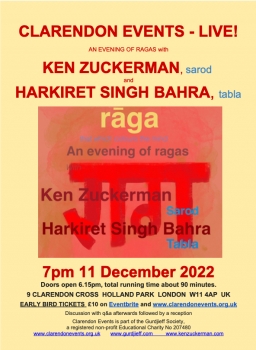
Sunday 11 December 2022 at 7pm
Evening Ragas followed by a short discussion, then a reception and a glass of wine.
This will be a delightful evening with Ken, an internationally acclaimed master of the Sarod and Harkiret, a fine young tabla player and teacher.
We look forward to welcoming you!
Tickets are available at the door (cash only) or through Eventbrite
Enquiries only 07887 506848
Ken Zuckerman, Grammy-nominated and internationally acclaimed as one of the finest sarod virtuosos performing today, has also been called “…one of the world’s most eclectic masters of improvisation.” He completed thirty-seven years of training under the rigorous discipline of India’s legendary sarod master Ustad Ali Akbar Khan, up to the maestro’s passing in June 2009. Ken also performed with Maestro Khan in numerous concerts in Europe, India, and the United States.
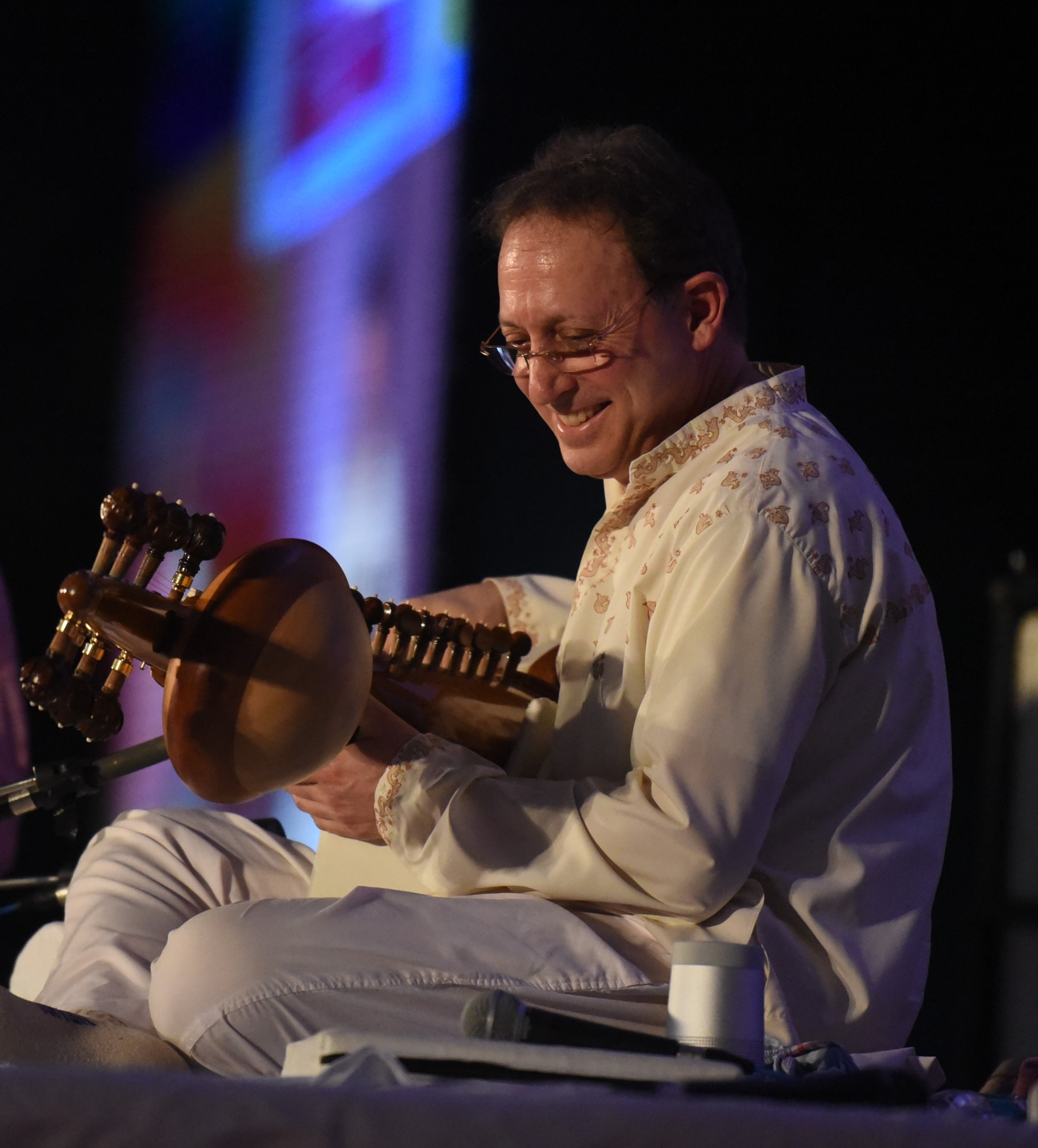
Photo: Shyam Sonar, The Times of India
In addition to performing classical Indian music with some of India’s finest tabla virtuosos (Swapan Chaudhuri, Zakir Hussain and Anindo Chatterjee), Ken has been at the vanguard of numerous cultural “crossover” projects. These include the Grammy nominated CD “Diaspora Sefardi” (Hesperion XXI), “Modal Tapestry I & II”, (Zuckerman’s compositions for an ensemble of 14 musicians from diverse traditions), and “Meeting Two Worlds of Modal Music” with the medieval singer, Dominique Vellard. The second CD of this unique collaboration, “Indian Ragas & Medieval Song”, was named a “Top of the World” CD by Songlines Magazine.
In recent years Ken has also made significant contributions to the development of India’s traditional instruments through various innovations and inventions. The innovations include:
- The integration of precision geared tuners into the traditional pegs of the sarod and tanpura
- Wooden resonators, which have increased the volume and tonal quality of the sarod
- A sarod bridge add-on which allows for micro adjustments of the bridge placement.
His recent invention, “Shanti”, is the world’s first device which automatically plays an acoustic tanpura, giving both musicians and audiences the pure acoustic sound of the tanpura in any practice and performance setting.
In addition to his extensive performance schedule, Ken Zuckerman has directed the Ali Akbar College of Music in Switzerland for 37 years and is also a professor at the Music Conservatory of Basel where he conducts courses in both North Indian classical music and the music of the Middle Ages.
Quotes
“Sarod maestro Ken Zuckerman from Switzerland, gave justice to the raga Chandranandan, conceived by his guru Ali Akbar Khan, combining Jogkauns and Nandkauns, with his delicate and thoughtful handling. He never transgressed from its emotive appeal. Even raga Gorakh Kalyan that followed was handled with great dexterity, underlining his status as the foremost torch bearer of the Ali Akbar style.” Amit Karmarkar, The Times of India, December 14, 2019. Photo: Shyam Sonar, The Times of India
“In his hands one can hear the essence of the gharana. Ken Zuckerman has been a disciple of the sarod maestro Ustad Ali Akbar Khan, for the last 24 years. Within that period he has risen from a mere curious foreigner interested in fathoming the secrets of the exotic East and its equally exotic musical fare, to being one of the foremost performers of the art.” Subhra Mazumdar, The Hindustan Times, Feb.10, 1996
“The impossible becomes achievable when unbounded capacity for hard work is coupled with talent of a high order. Few can hope to plumb the depths of the ocean that is Indian classical music; most barely skim the surface. Listening to Ken Zuckerman on the sarod at the India International Centre, one was humbled by the realisation of just how long and hard he must have worked to provide such aesthetically articulate music. One was awed by the quality of his talent, for boundaries of country, language and custom were swept away by the passion of his determination to master not only a difficult, fretless instrument, but also the mysteries of classical music. Ken has achieved what very few Indians have – become a worthy disciple of Guru Ali Akbar Khan. Surely this is the highest tribute a student can pay a teacher; to prove himself worthy of receiving knowledge and utilising it to the full. It is also the acid test of a Guru, to be able to inspire a disciple to such heights of excellence.” Bandana Malhotra The Hindustan Times, Jan.30, 1996
“The “maihar touch” in his music is not superficial but a product of deep involvement backed up by systematic hard labour. It is this sincerity that makes it difficult to believe that he is not an Indian by birth unless one hears his name or sees him play…Bravo American Sahib!” Subroto Roy Chowdhury, Calcutta Asian Age, April 26, 1996
A complete mastery over the instrument, pure raag structure and note sustenance are the great qualities of this artiste.
Here was a master who had fully harnessed the power of the sarod – the finest of sarod players outside India – an American now living in Switzerland. After a standing ovation and an encore, Ken treated us to yet another enlightening and delightful raag. It was pure magic.
Ali Akbar’s skill in the hands of a foreigner – It was also especially remarkable that in his Koushi Kanara there was the presence of the pure Ali Akbar mood. His control over the rag was an indication of good learning. Likewise, the deep musical sentiment that was there in his vistara of the padas in the alap is the proof of a class artist.
The torch-bearer of Maihar gharana, Ken, in his presentation of Kaushi-Kanada, unravelled the nostalgic pathos of the raga through alap, jor, gat in trital, extensive meends, outstanding ghasits, gamak, rhythmic variations in both Masidkhani and drut gat along with jhala and clear tankari.
Ken has assimilated within himself the very soul of Ali Akbar’s artistry.
…the music of the maestro flows in his veins…
HARKIRET SINGH BAHRA
Harkiret is an experienced Indian Classical Percussion player and Tabla teacher. He’s performed at numerous national venues such as The Royal Festival Hall, as well as across Europe and India.
When not recording fusional genre music with the likes of The Chris Woods Groove Orchestra, Harkiret teaches weekly Tabla classes in Kent and at the annual Chakardar Summer Retreat.
This Autumn we were delighted to collaborate with Harkiret and Chris Woods through our live music initiative ‘Live and Inspired‘. In just five days, Harkiret and Chris performed at 10 schools to more than 3000 students.
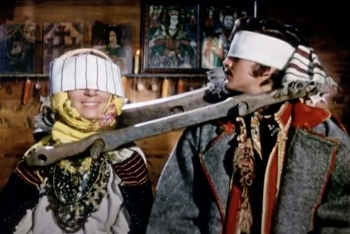
SHADOWS OF FORGOTTEN ANCESTORS (Wild Horses)
A FILM BY SERGEI PARADJANOV 1965 1 hour 31 mins
Licensed by the Aleksandr Dozhenko Film Institute in Kyiv.
Sunday 20 November 2022 at 7pm
For Concession tickets please enter 'concession' in
Promo Code which is above "General Admission'.
£10 Concession tickets also available on the door
Proceeds from this event will be donated to Save Ukraine charity. The film is followed by a reception.
This is a rare screening of one of the masterpieces of cinema. The copy has been kindly made available by the French Cultural Institute with the help of the British Georgian Society, and a licence obtained from the Aleksandr Dozhenko Film Institute in Kyiv.
"I am not a dissident. I am an artist." Sergei Paradjanov was a giant bear of a man,
intoxicated by beauty and life. Referred to simply as "Maestro", and revered worldwide
by directors such as Fellini, Antonioni, Godard, and Tarkovsky, his exuberant lifestyle and
his insistence on the integrity of his art landed him repeatedly in jail, denied the right to
make films. Despite this, he created masterpieces that have become acknowledged as the
defining works of three countries' cinema: Ukraine, Armenia and Georgia. This brilliant film,
not content simply to tell Paradjanov's extraordinary life story, evokes in its pyrotechnic
kaleidoscopic style the joyous artistic soul of the master himself. It is an unforgettable,
ecstatic hymn to one of cinema's greatest, if still far too little known, giants.
A timeless Carpathian story, the young Ivan falls in love with Marichka the daughter of his father's killer, among the Hutsui people of Ukraine, a tale reminiscent of Shakespeare's Romeo and Juliet. The camera technique of Paradjanov was groundbreaking and influenced a generation of great film makers. The sound track and portrayal of folk and shaman rituals also are a unique record and of great interest. The atmosphere of this movie which evokes the terrifying supernatural power of nature is gripping and beautiful, with fine performances from the brilliant cast. This is not a great narrative movie, it is a poetic drama, more like opera, like dance, even at times like a mystery play, and provides the audience with a unique and unforgettable experience.
Tickets at the door (cash only) and in advance from Eventbrite.
Enquiries only: 07887 506848
THE GATES OF SHINTO
A documentary film by JEAN CLAUDE LUBTCHANSKY
Co-directed by Gabrielle Lubtchansky and Mikaël Lubtchansky
Sunday 19 June 2022 at 7.00 pm
Donations on the door £10 (£5 students)
SORRY, RESERVED TICKETS ARE SOLD OUT ON EVENTBRITE
UNRESERVED TICKETS WILL BE AVAILABLE AT THE DOOR
PLEASE NOTE THIS IS A LIVE SCREENING AT 9 CLARENDON CROSS, LONDON UK, NOT A STREAMED EVENT.
IN ORDER TO SEE THIS FILM ON THE INTERNET PLEASE VISIT:
https://vimeo.com/ondemand/
Shinto, still largely unknown in the West, is based on the intimate relationship between Man and Nature. Kami, the invisible spirits (in trees, waterfalls and animals) represent the creative forces of the Universe and are at the heart of Shinto, a religion without a founder, doctrine, or sacred texts.The Gates of Shinto is the first film to show the different aspects of this tradition which is the source of Japanese culture and still very much alive today. It tells the myth of the Sun Goddess, Amaterasu, on a pilgrimage which pays homage to Nature and the ancestors through martial arts and ceremonies in shrines, including rarely accessible rituals such as the night ceremonies within Ise sanctuaries. Support from the Association of Shinto Shrines made this film possible and opened the doors to the most remarkable Shinto shrines in Japan.
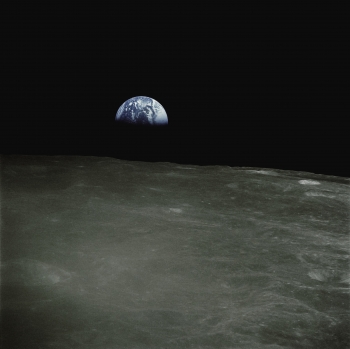
A PARTICLE OF A PARTICLE: IN THE MIDST OF PLANETARY CRISIS HOW CAN THE INDIVIDUAL HELP?
A ZOOM TALK by
CHARLES LANGMUIR, Higgins Professor of Geochemistry, and Director of the Geological and Mineralogical Museum, Harvard University
Sunday 25 April 2021 at 7.00pm UK TIME
Continuing his exploration with us of the planetary crisis, in this talk with Q&A Professor Langmuir will make special reference to the question of individual responsibility.
PLEASE NOTE:
DUE TO THE NUMBER OF PARTICIPANTS VIDEO WILL BE SWITCHED OFF AND AUDIO WILL BE MUTED. A KEYBOARD WILL BE NEEDED IN ORDER TO TAKE PART IN Q&A.
FILM: THE SEEKERS OF TRUTH (1) LINKS (English and Spanish)
GEORGI IVANOVITCH GURDJIEFF
YOUTUBE PREMIERE
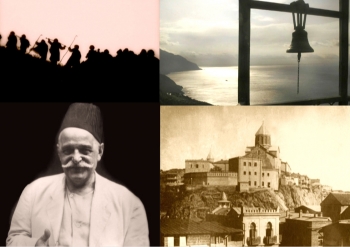
Saturday 27 March 2021 at 6.0pm (UK time)
The first film (2005) in a series of three dedicated to the work of
G. I. Gurdjieff, showing his unending search from early years in the Caucasus to his last days in Paris, accompanied by those who later carried on his Teaching. A link to this event will be sent to
subscribers and shown here nearer the time of the screening.
It will be available to watch only at this time, not later.
Running time 72 minutes
FRAGMENTS FROM THE MUSIC OF WHIRLING DERVISH CEREMONIES
Listen to the Ney how it tells a tale complaining of separations.
KUDSI ERGUNER Nay flute
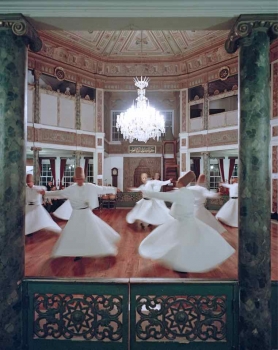
Sunday 26 April 2020 at 7pm
THIS EVENT IS POSTPONED
There will be an automatic waiting list in case of overboooking, please follow instructions from Eventbrite
DOORS OPEN AT 6.15
Please note that latecomers cannot be admitted
-----------------------------------------------------------------------------------------------------------------------------
KUDSI ERGUNER, one of the foremost nay masters of our times, is particularly famed for his activities helping to introduce Ottoman and sufi music to the world with internationally acclaimed projects and recordings. He lives and works in Paris as a musician, composer, musicologist, teacher and author.
Erguner comes from a family of Turkish musicians. His contact with many famous musicians from the older generation, who continually passed through his parents house, and his involvement with various Sufi brotherhoods, whose music and teachings Erguner studied, left their decisive marks on him. He received his training directly from his father, Ulvi Erguner, who was the last great master of the Nay.
Kudsi Erguner studied also architecture and musicology in Paris, he has given concerts and played in major festivals throughout the world and has researched the music of India, Pakistan and Turkey, grounded diverse music ensembles, recorded numerous albums and has worked with such well known artists such as Robert Wilson, Peter Gabriel, Maurice Bejart, Carolyn Carlson, Peter Brook, Didier Lockwood, Michel Portal, Tony Gatliff, Marc Minkovsky, Alexandre Desplat, Bartabas, Sarkis, Marcus Stochausen, Nusret Fathi Ali Khan, Christof Lauer, Renaud Garcia Fons, Michel Godard, Jordy Savall, Fazil Say.
Erguner has thus made authoritative contributions to world music. He has documented and revived nearly forgotten musical tradition and brought them to the attention of the Western public, securing them a place within Europe’s cultural inheritance in this way he did also initiate the renaissance of the Ottoman Classical and Sufi music in Turkey.
He has devised many original projects for the International Music Festivals. He released more than hundred CD mostly dedicated to the different aspects of the Ottoman music and published four book in french. In 1981 he created the MEVLANA association in Paris where he teaches music and Sufism according to the original tradition. He also gives conferences on Sufism and its music all over the world, and steers twp small communities connected to the Mevlevi tradition, one in Paris, the other in Histanbul.
He is been designated as a UNESCO Artist for Peace in May 2016. He was also awarded an honorary doctorate by Bulent Ecevit University in Turkey in 2014 and by the University of Arts Audiovisuels Scopje in Makedonia in 2018.
In parallel with his concerts and activities, he works as a professor at the Rotterdam Conservatory (CODARTS) and leads a master class (Birun) at the Cini Foundation - Venice every year.
NEY FLUTE
Listen to the Ney how it tells a tale complaining of separations …
Thus begins Mathnevî's first couplet, the Ney is, here, a metaphor for the human being.
The reed (Ney), before becoming a flute, is separated from its natural environment, after being cut, it’s been hollowed out and cleaned by red-hot rod.
Man experiences a similar feeling of separation from his divine origin, even if he does not remember it; he is subjected to a state of forgetfulness and distraction from the moment he is clothed in flesh and submitted to his own nature.
The plaintive sound of Ney evokes this state of separation, Its melodies are similar to the words of the accomplished Man.
Anyone who hears his melancholy speech is placed in a state of recollection, of recalling his state of the pure spirit. As a result, the Ney was listened to in the Sufi brotherhoods of the Mevlevi order with the same attention as listened to Rumi himself. Because in this poetic metaphor the Ney is Rumi himself.
THE CEREMONY OF SAMÂ, the Sufi brotherhood Mevlevî, disciples of Mevlânâ Djalâl ad-din Rûmî (1207-1273), is known in the West under the name of "Whirling Dervishes". The ritual of Samâ (listening) is considered as an invitation and preparation for a state of the soul to become into union with the One.
The ritual is formed by two stages, first long meditative moments followed by a procession and the whirling movement.
MUQABALA: (meeting) The most important part of this ritual consists in greeting each other with respect and stands face to face because the one who refuses to greet the Man would be worse than the Devil.
Only after praying and meditating will the emotion turn into motion.
This part is accompanied by a prelude (Peshrev) of procession.
MOVEMENT. In this second part, listening to a musical work called Âyîn specially composed by great musicians of classical music on the poems of Rumi initiate the danse called sama. These compositions are masterpieces of the world of modal music (Maqam), by their size and refinements we can compare this musical form to oratorios of Western music. The musical form of Âyîn is made up of three anonymous works dating from the 15th century. Structured by four parts called Selâm which are composed on well defined rhythmic cycles. Kudsi Erguner propose to interprete with his Ney a selected repertoire of various parts of the Ayins on several maqâms.
PROGRAMME
Fragments from the :
- Âyîn Pendjgâh composed by Abd al Rahmân Molla Djamî (1414-1492)
- Âyîn Bayâtî composed by Kûçek Dervish Mustafa Dede ( ?1683)
- Âyîn Segâh composed by Buhurîzâde Mustafa Itrî (1640-1711)
- Âyîn Hidjâz composed by Nâyî Osman Dede (1652-1729)
- Âyîn Adjém-Ashîrân composed by Hüseyin Fahreddîn Dede (1854-1911)
- Âyîn Ferahfezâ composed by Hammâmîzâde Ismâil Dede (1778-1846)
THE GATES OF SHINTO ******* CANCELLED *********
A DOCUMENTARY FILM BY JEAN-CLAUDE LUBTCHANSKY
Co-directed by Gabrielle Lubtchansky and Mikaël Lubtchansky
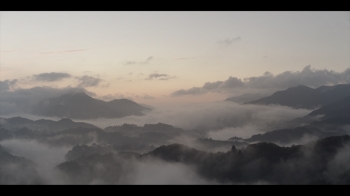
Sunday 22 March 2020 at 7pm
EVENT CANCELLED
WE EXPECT TO RESCHEDULE THIS FILM LATER IN THE YEAR
A documentary film by Jean-Claude Lubtchansky, co-directed by Gabrielle Lubtchansky and Mikaël Lubtchansky and produced by Jon Pepper for Mulberry Tree (Length 66 minutes).
Shinto, still largely unknown in the West, is based on the intimate relationship between Man and Nature. Kami, the invisible spirits (in trees, waterfalls and animals) represent the creative force of the Universe, and are at the heart of Shinto, a tradition without a founder, doctrine or sacred texts.The Gates of Shinto is the first film to show the different aspects of this tradition which is the source of Japanese culture, and still very much alive today. It tells the myth of the sun goddess, Amaterasu, on a pilgrimage which pays homage to Nature and the ancestors, through martial arts and ceremonies in shrines, including rarely accessible rituals such as the night ceremonies within Ise sanctuaries.Support from the Association of Shinto Shrines made this film possible and opened the doors to the most remarkable Shinto sites in Japan.
PLACES CAN BE RESERVED FREE HERE ON 'EVENTBRITE
There is an automatic waiting list in case of overbooking. Please follow the instructions from Eventbrite.
DOORS OPEN AT 6.15PM
Please note that latecomers cannot be admitted
We look forward to welcoming you.
MATHEMATICS IN NATURE, THE COSMOS, AND ART
A guide for beginners by
RICHARD TEMPLE
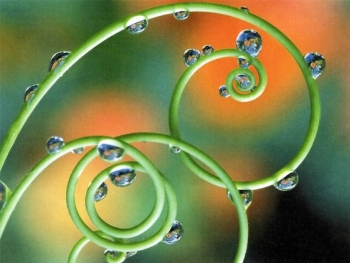
Sunday 23 February 2020 at 7pm
SORRY THIS EVENT IS NOW FULL. NO MORE PLACES AVAILABLE
THE MUSIC OF G.I.GURDJIEFF/THOMAS DE HARTMANN
A CONCERT OF PIANO MUSIC ARRANGED FOR CHAMBER ENSEMBLE
THE GURDJIEFF SOCIETY ENSEMBLE
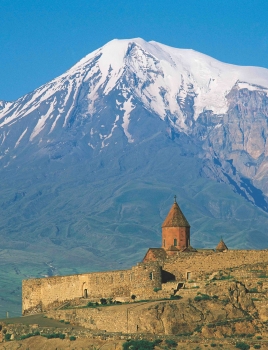
Sunday 15 December 2019 at 7pm
Reserve your free ticket on EventBrite!
A concert of G.I.Gurdjieff/Thomas de Hartmann piano music arranged for small instrumental ensemble made up of musicians from UK and international Gurdjieff Societies.
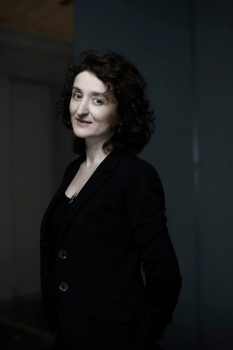
GEORGIAN POLYPHONIC SINGING
A WEEKEND WORKSHOP, FRIDAY 3pm SATURDAY and SUNDAY ending 2.30pm
NANA MZHAVANADZE
Friday 6 December 2019 at 3pm
6-8 December 2019.
A workshop with
NANA MZHAVANADZE
from Tbilisi - Georgian polyphonic singing.
Enquiries welcome - limited places are available.
This is a return visit from our much loved teacher from Tbilisi.
enquiries@clarendonevents.org.uk
or contact us on 07887 506848
The proposed contribution for non-residents is £70 including meals.
WHENCE COMETH OUR HELP
AN EXPLORATION BY
ROGER LIPSEY
Sunday 10 November 2019 at 7pm
Whence cometh our help?
Summoning our best – a global coalition of science and wisdom
An exploration with Roger Lipsey
Many thoughtful people feel pinned to history, as if to a descent that cannot be remedied. Global warming, mass species extinction, an arms race at extremes of technology, wars and failed states generating mass migration, a persistent romance with violence, the international order shaken, the rights of minorities and women ignored or derided: where are we, what are we? Is this the generation or set of generations that will lose the Earth? Are we so deeply foolish and unconscious that we deserve no better?
There is a vision past this threat. As Václav Havel might have said, it is barely perceptible ‘at the horizon’ – but it calls and invites. To realise this vision asks for everything: seriousness of mind, sufficiently sound leadership, sufficiently principled politics, science and technology that serve human welfare and our planetary home. It calls for wisdom – for the core of self-knowledge, conscience, and a sense of the sacred at the center of every religious and spiritual tradition. The need for wisdom and consciousness is too little understood. We cannot bash our way forward any longer.
We need a global coalition of science and wisdom. The elements are ready. Science and wisdom in our time are equal to the task. It is likely not too late. It is late. Dag Hammarskjöld said of the United Nations that it ‘was not created in order to bring us to heaven, but in order to save us from hell’. Thoughts not only for the UN.
‘From whence cometh my help?’ asks Psalm 121. We must do our part – a grave, marvelous challenge – if later verses of the psalm are to prove true: ‘The Lord shall preserve thy going out and thy coming in’.
• Dr Roger Lipsey is a biographer, art historian, editor and translator. He has written on Dag Hammarskjöld, G I Gurdjieff, Thomas Merton, Ananda K Coomaraswamy, and the history and interpretation of 20th-century art. His next book, Politics and Conscience: Dag Hammarskjöld on the Art of Ethical Leadership, a compact handbook of Hammarskjöld’s political thought and practice, will be published by Shambhala Publications in February 2020.
TICKETS ON SALE NOW!
Tickets also will be available at the door.
THE MUSIC OF THOMAS DE HARTMANN
THE SOUND OF COLOUR
THE THOMAS DE HARTMANN CONSORT/ELAN SICROFF PRE-CONCERT SPEAKER 6PM
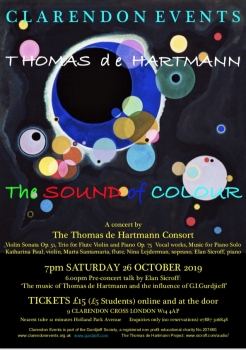
Saturday 26 October 2019 at 6pm
NOTE! PRE- CONCERT TALK AT 6pm
DOORS OPEN 5.30pm
Following a well-received performance last Autumn 2018, the Thomas de Hartmann Consort will return to Clarendon Events with an exciting new programme:
Trio for Flute, Violin and Piano Op. 75,
Sonata for Violin and Piano Op. 51 (heard in part in October 2018),
Vocal works in a wide variety of styles,
Music for solo piano.
Katharina Paul, violin
Marta Santamaria, flute
Nina Lejderman, soprano
Poppy Walshaw, cello
Elan Sicroff, piano
Enquiries only (no reservations) 07887 506848
The Thomas de Hartmann Project: www.sicroff.com/audio/
PLEASE NOTE THAT THIS IS A SATURDAY EVENT, NOT SUNDAY AS USUALLY...
ALSO... THERE WILL BE A PRE-CONCERT TALK BY
ELAN SICROFF AT 6PM.
'THE MUSIC OF THOMAS DE HARTMANN AND THE INFLUENCE OF G. I. GURDJIEFF
Please note that donations via paypal will not be acknowledged by us and no tickets will be issued
Paypal sends you a notification and we will have a list of names at the door with the amounts donated.
PIANO RECITAL
MUSIC OF THE STARS
BY DISTINGUISHED RUSSIAN PRIZE WINNING PIANIST KONSTANTIN LAPSHIN
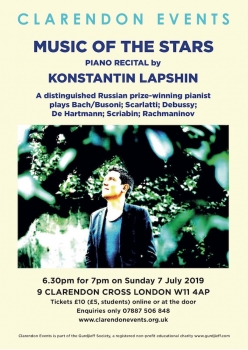
Sunday 7 July 2019 at 7pm
PAYPAL CLOSED.... PLEASE BUY TICKETS AT THE DOOR, THANKS....
Bach/Busoni; Scarlatti; de Hartmann; Scriabin; Rachmaninov
Konstantin Lapshin is a distinguished London-based Russian pianist who has been a prize-winner in more than 15 international and national competitions. Konstantin has recently been awarded a doctoral degree at the Royal College of Music, where he is also a piano teacher. During his time at the RCM, Konstantin won the Chappell Gold Medal, RCM Concerto Competition, Kendall Taylor Beethoven and Joan Chissel Schumann Prize Piano Competitions, as well as the college’s highest prize for the most outstanding student (across all disciplines), the Queen Elisabeth Rose bowl. He subsequently played for HRH Prince Charles and was nominated ‘Rising Star’ to play at Cadogan Hall, London. Konstantin has also performed in the Royal Albert Hall, Wigmore Hall, Bridgewater Hall in Manchester, Salle Cortot in Paris, Great Hall of Moscow Conservatoire and Piano Salon Christophori in Berlin among the other concert halls. In 2014, Konstantin was invited to play Rachmaninov’s Concerto No.3 with the Odessa Philharmonic Orchestra under the conductor and pianist, Mikhail Pletnev, as part of a Rachmaninov Festival.
Konstantin is also much in demand as a chamber musician. His collaboration with British violinist Madeleine Mitchell has let to a number of important performances, including the Baxton International Festival, Leeds University International Concert Series as well as concerts in London venues. The CD of the music by Welsh composer Grace Williams recorded in collaboration with M. Mitchell and other musicians has recently been named 'The CD of the week' by the 'Guardian' and was 2nd in the UK classical music charts.
“An impressive technique, and the impulsive and Romantic expression that has been a hallmark of so many Russian pianists, including Rachmaninov and Horowitz” – Fanfare magazine (USA) on Lapshin.
www.konstantinlapshin.com
CAN AN UNDERSTANDING OF THE EARTH INFORM A SEARCH FOR CONSCIOUSNESS?
AN ILLUSTRATED TALK with Q & A
CHARLES LANGMUIR
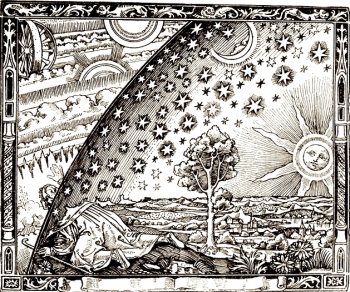
Sunday 2 June 2019 at 7pm
Earth is one example of the trillions of planets orbiting in the habitable zone of their star. Earth has gone through a process of planetary evolution from barren rock to technological civilization. What is the potential role of intelligent life in this planetary process?
Charles Langmuir is the Higgins Professor of Geochemistry at Harvard University, and a fellow of the National Academy of Sciences and the American Academy of Arts and Sciences.
DIVINE CONCEPTION
The Art of the Annunciation
An illustrated talk by SARAH DRUMMOND
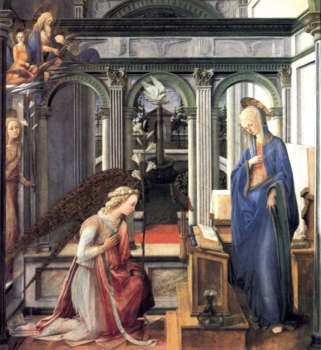
Sunday 7 April 2019 at 7pm
How does an artist convey the divine in the human, evoke the invisible in the visible, allow us a glimpse into another dimension? Sarah Drummond, a writer and journalist with a special interest in the history of art and in education, explores some images of the Annunciation, one of the most frequently depicted scenes in Christian art.
Tickets also available at the door
Doors open 6.30pm
Enquiries only 07887 506848
Unfortunately late-comers cannot be admitted.
Sarah Drummond is the author of a richly illustrated book of the same title, published in 2018 by Unicorn Publishing Group. Copies will be available at the event. Amongst the reviews, one by Sister Wendy stands out: 'Here is a book of true scholarship - meditated scholarship - luminous with spiritual insight. The images of Our Blessed Lady are very wide-ranging, from the well know to the almost unknown, and this in itself would make this beautiful book precious."
Image: Annunciation, C.1443, by Filippo Lippi,
Alte Pinakothek, Munich
Who’s there? Shakespeare’s Inner World
A TALK BY THEATRE DIRECTOR
SIMON GODWIN
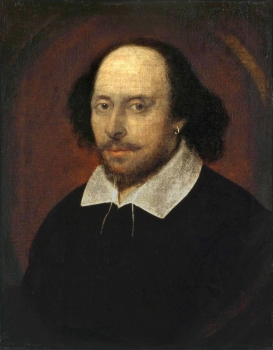
Sunday 17 February 2019 at 7PM
PAYPAL IS NOW CLOSED. ENTRANCE WILL BE AVAILABLE AT THE DOOR.
There are many theories about Shakespeare the man, while his monumental body of work, containing some of the most profound insights into human nature, stands alone. What can we learn from his characters, his plots and his text and what can they tell us about the man himself?
Simon Godwin has directed The Two Gentleman of Verona, Hamlet and Timon of Athens for the RSC, and Twelfth Night and Antony and Cleopatra for the National. Join us for this fascinating talk, followed by a discussion.
SIMON GODWIN IS A NATIONAL THEATRE/ROYAL SHAKESPEARE COMPANY DIRECTOR
MUSIC OF G.I.GURDJIEFF/THOMAS DE HARTMANN
A SELECTION OF PIANO MUSIC ARRANGED FOR INSTRUMENTS
INTERNATIONAL GURDJIEFF ENSEMBLE
Sunday 9 December 2018 at 7.00PM
Programme details will be announced soon.
ODYSSEY
HUGH LUPTON and DANIEL MORDEN
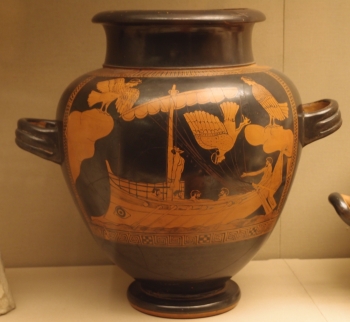
Sunday 4 November 2018 at 7.00PM
Homer’s epic tells of the 10-year struggle of a man trying to return home. During his long voyage back to Ithaca, Odysseus outwits mythical creatures, angry gods and seductive witches. In the end, though, it is not his courage, strength or even luck that allows him to prevail – it is his cunning. It is not for nothing that he is known as ‘wily Odysseus’. The Odyssey is shot through with wry humour and poetic reflection that reveals the profound human observation of the Homeric vision.
Two of the UK’s most popular storytellers and award-winning authors, Hugh Lupton and Daniel Morden have toured the world telling traditional stories in performance.
THE MUSIC OF THOMAS DE HARTMANN
A search for meaning in turbulent times
THE THOMAS DE HARTMANN CONSORT
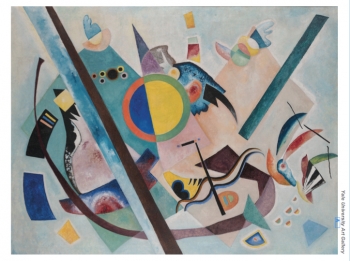
Sunday 14 October 2018 at 7.00PM
CLARENDON EVENTS KINDLY REQUEST THAT IF POSSIBLE YOU BRING YOUR PAYPAL RECEIPT WITH YOU TO THE TICKET DESK ON THE EVENING. WE DO NOT ISSUE TICKETS OR FURTHER RECEIPTS. THANKS.
The Thomas de Hartmann Consort presents a wide-ranging programme of
De Hartmann's works.
Elan Sicroff, artistic director and pianist, Nina Lejderman, soprano,
Katharina Paul, violin, Poppy Walshaw, cello
PROGRAMME
Sonata for Cello and Piano Op.63
Tema con Variazione (2nd movement) Poppy Walshaw, cello — Elan Sicroff, piano
Concerto Op. 61, 1st movement Elan Sicroff, piano
(w/o orchestra)
Hommage a Borodine Katharina Paul, violin — Elan Sicroff, piano
Scyte (from the opera Esther, Op. 76) Katharina Paul, violin — Elan Sicroff, piano
Short Interval
Sonata for Violin and Piano Op. 51 –
Moderato (1st movement) Katharina Paul, violin — Elan Sicroff piano
La Kobsa, No. 1 Poppy Walshaw, cello
Deux Pleureuses Op. 64 No. 1 Poppy Walshaw, cello — Elan Sicroff, piano
Love of a Poet Op. 59
Nine Songs from Pushkin Nina Lejderman, soprano — Elan Sicroff, piano
1) The Nereid 2) I Remember the Sea Before the Storm 3) Night 4) I Still Recall the Magical Moment
5) The Nightingale and the Rose 6) Omens 7) I Loved You Once 8) What Means My Name to You?
9) The Last Flowers
Born in the Ukraine into an aristocratic Russian family in 1885, Thomas de Hartmann as a young man was a successful and honoured composer. A life-long friend of abstract artist Kandinsky, he shared with him and his circle the search for new expression through union of the arts. In 1916 he met G.I. Gurdjieff in St Petersburg and then followed him for 12 years, famously collaborating on over 300 works of sacred music. In 1929 he returned to Paris and to his own music with a new search for meaning. He died in America in 1956.
www.facebook.com/TDHProject www.sicroff.com
SEEING, SEARCHING, BEING
WILLIAM SEGAL
THREE FILMS BY KEN BURNS
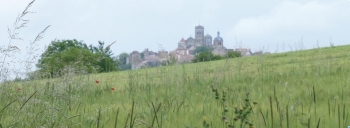
Sunday 8 July 2018 at 7.00PM
- William Segal. A documentary filmed in Segal’s art studio and garden.
2. Vézelay. Its magnetism and serene beauty inspired Segal and Burns to examine the question of search.
3. In the Marketplace. Shot in the streets of Paris showing daily life in preparation for an exhibition of Segal’s photographs.
WILLIAM SEGAL (1904-2000) WAS A PHILOSPHER, PUBLISHER, WRITER AND PAINTER. HE WAS A SENIOR MEMBER OF THE NEW YORK GURDJIEFF FOUNDATION AS WELL AS A STUDENT OF D.T.SUZUKI. SEGAL HELPED BRING TOGETHER EASTERN AND WESTERN SPIRITUAL TRADITIONS .
https://www.nytimes.com/2010/08/01/arts/television/01burns.html
MUSIC OF THE SPHERES OF BEING EVENT CANCELLED
CONCERT BY DAVID HYKES
DAVID HYKES with Elizabeth Nott (frame drums)

Sunday 10 June 2018 at 7.00PM
EVENT CANCELLED
David Hykes is a visionary composer, singer, musician, artist, and teacher of contemplative music called harmonic chant which blends music, meditation, training and healing harmonisation practices. His practice derives from an early study of Mongolian overtone singing (also called 'throat singing') which he was one of the first in the west to discover. Those familiar with the film about the young Gurdjieff called "Meetings with Remarkable Men" will be interested to know that it was the voice of David Hykes which reverberated in the hills and won the ashok's competition at the start of the film (although David is not seen on film).
'David Hykes has opened a new dimension in music bringing us the music of the spheres. It is the music of overtones which holds sway throughout the universe… As music, these wondrous sounds retain an extraordinary mystery, for they make every listener feel humble and yet part of the great Whole.' Yehudi Menuhin
More information can be found here: http://www.harmonicworld.com/
Elizabeth Nott (frame drums) is a specialist MIddle Eastern percussion player who studied at SOAS and now works as a freelance. This is her first collaboration with David Hykes. For more information follow http://www.elizabethnott.co.uk/
TICKETS ARE ALSO AVAILABLE AT THE DOOR.
For enquiries only please call 07887 506848
Image "108 Harmonic Visions" series by David Hykes © 2018
PAYPAL Note payment can also be made by credit and debit card using this link. Please print out your receipt and bring it with you to help the ticket desk, thanks.
SEMINAR WITH DAVID HYKES EVENT CANCELLED
HARMONIC PRESENCE
DAVID HYKES

Saturday 9 June 2018 at 9.30am to 4pm
EVENT CANCELLED
THE SEMINAR WILL BE HELD AT 9, CLARENDON CROSS LONDON W11 4AP
Nearest tube Holland Park Avenue (10 minute walk).
PAYMENT ALSO AT THE DOOR £50 FOR THE DAY, £25 STUDENTS.
MORNING ONLY WILL BE CHARGED AT £25, £15 STUDENTS.
THE SESSIONS WILL BE:
Morning: 9.30am to 12.30am Break for lunch, found locally, or BYO. Afternoon: 2pm-4pm
Tea and coffee only provided.
For enquiries only please call 07887 506848
More information can be found at www.harmonicworld.com
Interview with David Hykes:
Q: Could you explain the basic concept of harmonics?
A: The general undertitle that I use in retreats and seminars is The Music of the Spheres and the Harmonics of Being. Whether we approach harmonics from an artistic, spiritual, scientific, metaphysical, musical, cosmological or acoustical perspective, harmonic presence is everywhere throughout the universe. It is present in how nature, energy and form arise, remain, and disappear -- the wave-like, impermanent nature of all phenomena. The endless cycles… arising, remaining, disappearing… understanding this in all octaves is the key to our liberation -- to the awakening of our Buddha Nature, to the awakening within the Holy Sun Absolute. Pure primordial awareness free of identification… the spontaneous nature of the arising of all phenomena… how the transparent, immaculate original Seeing Light, embodying mind and space as one, gazes impartially on the phenomenal surge. How silent we are and how aware we are… these together can transform us so completely that we witness with profound feeling this omnipresent arising, remaining, and dissolving of all phenomena. Our pure perception can become a constant OFFERING, a constant ACCOMPANIMENT to "all that is."
On the human level, it’s an attempt to embody a music that includes the spheres of our own harmonic being, so that our FULL-SPECTRUM EXPERIENCE is that of being awakened "first responders in the present moment," through development of our pure vibrational qualities -- compassion, loving-kindness, tolerance, selflessness, humility, confidence, clarity, good will toward oneself and others, the capacity to listen to, attune to, accompany and harmonize with beings and phenomena in any octave, any moment in this "multi-tiered reality", as Lord Pentland once described it. The quality of our manifestations (or harmonic vibrations, if you prefer) is always equal to the spectral quality energy of which we are composed.
Simply in terms of "hearing harmonics" and "making harmonics", many people who get interested in this kind of sound have fairly specific associations, limited often to world music from central Asia -- Tuva, Mongolia, Tibet… That limited definition doesn’t work for me, because harmonics are the nature of all musical sound -- the DNA of all music, in every sphere. It is found at various levels, or octaves, throughout the universe. Just like light, heat, gravity… harmonic presence is universal.
Then there is the "healing sounds" approach -- which if I may be permitted a little friendly jab, has very largely inspired itself from our Harmonic Presence work since 1975. Some people consider that there is an automatic healing sound aspect to harmonics and I find that quite naïve, when it is without the necessary musical and spiritual and psychological knowledge behind it.
What is also necessary to understand is that harmonics are not just quantitative, i.e. something you measure in sound, whether in the cosmic microwave background or in the spectral analysis of musicology, or as those naive New Age snake-oil ideas about "magic frequencies," but something QUALITATIVE. There are subtle levels of vibration, subtle octaves, that go far deeper and further in ourselves than anything merely sonic. Only deep contemplative work can help us be in necessary harmonic state of being -- ever-more deeply silent, ever-more deeply aware, ever-more deeply spacious -- to "pass through the narrow gate" of our habitual, noisy, egoistic identifications -- the dead zones in the sea of being -- and truly find the pure primordial qualities of being. Since there are so many self- appointed "harmonic experts," "sound healers", etc. now, not to mention the shallow virtuosity problem of many harmonic vocal performers, it's really worth being careful about the trap of confusing one's local noise with anything of an authentically greater nature. The more "humble pie" we eat, the better. Period.
The study, practice and cultivation of harmonic qualities, the harmonics of being, the vibrations of being, is so much more interesting, vital and organically far-reaching inside ourselves, and in terms of how we relate to ourselves, to others, to life just as it is, to nature…
So, anyway, in the Harmonic Presence work, we try as best we can to practice in a way that includes these 3 main dimensions -- the music of the spheres dimension, the contemplative dimension, and the healing harmonization dimension. The point is to accompany with compassionate awareness the wave-like arising-remaining-and-dissolving of all phenomena, within and without. When thanks to the blessings of the teachers, the right relationship with the vibrational seed of all being is attuned, we are finally liberated, and we can joyfully serve anywhere, in any moment -- ACCOMPANIMENT.
BUDDHA SERIES.74. © David Hykes 2011
PAYPAL: Note that payments can be made by credit and debit cards using this link. Please print out your receipt and bring it with you to help the ticket desk, thanks.
MUSIC AND MEANING
BACH & GURDJIEFF/DE HARTMANN
LAURIE BLUNDELL, Piano, DIETRICH BETHGE, Cello
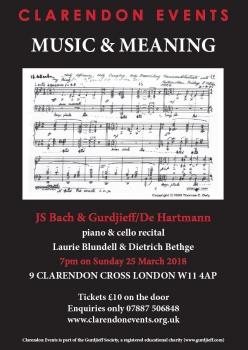
Sunday 25 March 2018 at 7.00PM
PROGRAMME
Laurie Blundell Piano Dietrich Bethge Cello
1.
J.S.Bach
Movements from Suite for Solo Cello No 1 in G major BWV 1007
Prelude, Allemande, Sarabande, Gigue
2.
J.S.Bach
Partita No. 1 in Bâ™ major, BWV 825
Praeludium, Allemande, Corrente, Sarabande, Menuet I, Menuet II, Gigue
SHORT INTERVAL
Music by Gurdjieff/de Hartmann
3.
Kurdish Shepherd’s Dance Bk 1 No 19
Armenian Song Bk 1 No 27
Tibetan Melody Bk 1 No 8
cello and piano
4.
Hymn for Easter Thursday Bk 3 No 41
piano
5.
Kurd Melody from Isfahan Bk 1 No 33
Bk 3 No 7
Assyrian Women Mourners Bk 1 No 32
cello and piano
6 .
Bk 1 No 12
piano
7.
Hymn No 5 Bk 4
Hymn No 8 Bk 4
Bk 3 No 5
Ancient Greek Melody Bk 1 No 42
cello and piano
***************************************************************
Donations: £10 (Students: £5).
Tickets available at the door on the day.
PLEASE NOTE START TIME 7PM
Enquiries only 07887 506848
We look forward to welcoming you.
BORN OF THE VIRGIN MARY
A study in Esoteric Christianity, an illustrated lecture by
Richard Temple
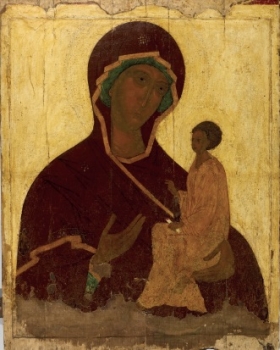
Sunday 10 December 2017 at 7.30pm
The Virgin Mary's cosmic status and stages in her journey from human existence to her higher life in Eternity are examined; her Byzantine epithet Theotokos, 'Bearer of God', implies celestial events on a scale we cannot fathom. Yet the idea of the Queen of Heaven, manifesting as various goddesses whose feminine qualities became attributes of Mary, long predates Christianity. All this can be read in the symbolism of icons and in apocryphal writings.
PLEASE NOTE: Tickets on the door, no advance sales or reservations.
General enquiries only: 07887 506848
SOUNDS OF THE SUFIS
A RECITAL by
KUDSI ERGUNER
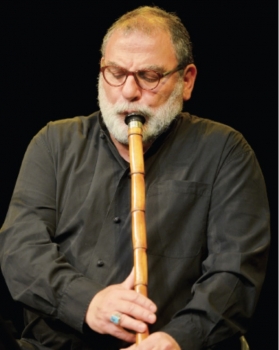
Sunday 5 November 2017 at 3PM
SORRY THIS EVENT IS FULLY SUBSCRIBED, NO MORE PLACES ARE AVAILABLE.
KUDSI ALSO WILL BE AT THE HELLENIC CENTRE ON 6 NOVEMBER
http://helleniccentre.org/event/greek-side-ottoman-music-manuscripts-lampadarios/
A master of traditional Mevlevi Sufi music, Kudsi Erguner
is a world-renowned player of the Turkish ney flute.
He has worked with musicians as diverse as Peter Gabriel,
Maurice Béjart, Jean-Michel Jarre and Didier Lockwood
and also with the theatre and film director Peter Brook,
including in his 1978 film Meetings with Remarkable Men.
Born in Istanbul, he studied with his father and attended
the Sema of the Mevlevi-Sufi tradition and other Dervish
ceremonies. In the 1970s he moved to Paris
where he founded the Mevlana Institute, which is devoted
to the study and teaching of classical Sufi music.
Kudsi Ergüner was appointed UNESCO Artist for Peace in 2016.
THIS EVENT IS PRESENTED IN COLLABORATION
WITH THE TEMPLE GALLERY.
RESERVATIONS CAN BE MADE VIA THEIR EMAIL ADDRESS AND
PAID FOR ON THE DOOR
RICHARD@TEMPLEGALLERY.COM
UNRESERVED TICKETS £10 ALSO CAN BE PURCHASED
ON THE DOOR SUBJECT TO AVAILABILITY
PLEASE NOTE START TIME 3PM
-----------------------------------------------------------------------------------------------------------------------------
THE SEEKERS OF TRUTH
The life of G.I .Gurdjieff
A film by Jean-Claude Lubtchansky
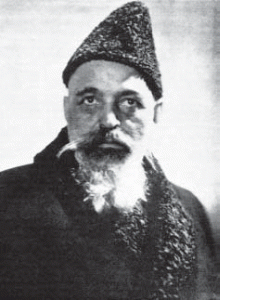
Sunday 2 July 2017 at 7.30pm
This film made in 2005 is dedicated to G.I. Gurdjeff and his Work. It shows his unending search from early years in the Caucasus, to his last days in Paris, where he died in 1949. He was accompanied throughout by those who later carried on the teaching which continues today.
Tickets also available at the door.
Doors open 7pm.
The film runs for 72 minutes
Enquiries only 07887 506848
Poems from Between Two Worlds
Poetry Reading
Roy Ashwell, Andrew Brenner, Anne Humphreys, Phyllis King, Maria Lockhart, Anthony Smith, Tilo Ulbricht

Sunday 21 May 2017 at 3.00pm
Donations at the door.
MESSIAH Part 2&3 (with omissions)
by George Frideric Handel
Clarendon Ensemble Singers and Instrumentalists
Sunday 26 March 2017 at 7.30pm
After our well received performance of MESSIAH: Part 1 at Christmas 2015 we are happy to offer Parts 2 and 3 of this unique work (with some cuts which will be announced). Parts 2 and 3 are based on New Testament texts describing the Crucifixion and Resurrection of Christ, appropriate for Easter time. The music of George Frideric Handel, so well adapted to the texts, amplifies the impact of this sacred drama and, with its unusually restrained orchestration, draws on a rich musical language which embraces the worlds of opera, Bach, Lutheran chorale, and English folksong. It ends with the majestic processional Amen chorus which echoes Palestrina, revealing in all its glory a unique mystical vision of the death and resurrection of Christ.
CLARENDON ENSEMBLE
Musicians from the Gurdjieff Society with talented singers from four London music schools.
Leader Clare Hoffman
Violin 2 Malu Lin Swayne
Viola Hilary Glanville
Cello continuo Dietrich Bethge
C/bass David Glanville
Oboe Herbert Lashner
Trumpet Kirsty Loosemore
Organ Monica Marubayashi
Sopranos Monica Marubayashi (solo) Mimi Doulton (solo) Elisabeth Rauch (solo)
Jane Metcalfe
Altos Anna Jeffers (solo) Natalie Sinnott (solo) Keith Pun (counter tenor)
Tenors Kieran White (solo) Robert Tilson Laurence Panter
Basses Sam Oram (solo) Michael Rakotoarivony Hugo Herman-Wilson
Directed from the harpsichord by Ben Pearce-Higgins
We look forward to seeing you.
Enquiries only 07887 506848
PROGRAMME
Introduction: J.S.Bach: Sinfonia from BWV 21 Church Cantata (Ich hatte viel Bekümernis)
Messiah part 2
22 Behold the Lamb of God (chorus)
23 He was despised (alto solo)
24 Surely He hath borne our griefs (chorus)
25 And with His stripes we are healed (chorus)
OMIT 26
27. All they that see Him laugh Him to scorn.
28. He trusted in God.
29 Thy rebuke hath broken His heart (tenor solo)
30 Behold and see (tenor solo)
31 He was cut off (tenor solo)
32 But Thou didst not leave His soul in Hell (tenor)
33 Lift up yout heads (chorus)
34-35 omit
36 Thou art gone up on high (alto solo)
37 The Lord gave the word (chorus)
38 How beautiful are the feet (soprano solo)
39 Their sound is gone out (chorus)
40 Why do the nations (bass solo)
41-43 omit
44 Halleluja (chorus)
Messiah part 3
45 I know that my Redeemer liveth (soprano solo)
46 Since by man came death (chorus)
47 Behold I tell you a mystery (bass solo)
48 The trumpet shall sound (bas solo)
49-51 omit
52 If God be for us (soprano solo)
53 Worth is the Lamb, Amen (chorus)
time 60 minutes approximately.
Harpsichord single manual German style (Eckhardt Merzdorf) by Andrew Wooderson
PROGRAMME NOTE
Messiah was composed in 1741 with a scriptural text compiled by Charles Jennens from the King James Bible,
and from the version of the Psalms included with the Book of Common Prayer. It was first performed in Dublin on
13 April 1742 and received its London premiere nearly a year later. After an initially modest public reception, the
oratorio gained in popularity, eventually becoming one of the best-known and most frequently performed choral
works in Western music.
Handel wrote Messiah for modest vocal and instrumental forces. In the years after his death, the work was adapted for performance on a much larger scale, with giant orchestras and choirs. In other efforts to update it, its
orchestration was revised and amplified by (among others) Mozart. In the late 20th and early 21st centuries the
trend has been towards reproducing a greater fidelity to Handel's original intentions, although b"big Messiah" productions continue to be mounted.
The music for Messiah was completed in 24 days of swift composition. The autograph score's 259 pages show some bsigns of haste such as blots, scratchings-out, unfilled bars and other uncorrected errors, but according to the music bscholar Richard Luckett the number of errors is remarkably small in a document of this length. The original manuscript for Messiah is now held in the British Library's music collection. At the end of his manuscript Handel wrote the letters "SDG"—Soli Deo Gloria, "To God alone the glory".
In early March 1742 Handel began discussions with the appropriate committees for a charity concert, to be given in April, at which he intended to present Messiah. The three charities that were to benefit were prisoners' debt relief, the Mercer's Hospital, and the Charitable Infirmary. In its report on a public rehearsal, the Dublin News-
Letter described the oratorio as "... far surpassing anything of that Nature which has been performed in this or any other Kingdom.” The takings amounted to around £400, providing about £127 to each of the three nominated
charities and securing the release of 142 indebted prisoners.
The warm reception accorded to Messiah in Dublin was not repeated in London when Handel introduced the work at the Covent Garden theatre on 23 March 1743. The first performance was overshadowed by views expressed in the press that the work's subject matter was too exalted to be performed in a theatre.
London's initially cool reception of Messiah led Handel to reduce the season's planned six performances to
performances at Covent Garden in 1745, on 9 and 11 April, and then set the work aside for four years. The 1749 saw its revival at Covent Garden, under the proper title of Messiah. The year 1750 also saw the institution of the annual charity performances of Messiah at London's Foundling Hospital, which continued until Handel's death and beyond.
It is striking that Messiah performances raised huge sums of money and saved the lives of hundreds of orphans. It was performed each year in the Foundling Hospital chapel, for the benefit of the charity, a tradition that continued until the 1770s. Handel conducted or attended every performance until his death in 1759. These concerts not only helped secure the Oratorio's place in the nation's affections, they succeeded in
raising the huge sum of £7,000 for the charity. As a final act of generosity, Handel left in his will a fair copy of the
Messiah score to the governors of the Foundling Hospital, thus enabling the charity to continue staging the benefit concerts – which they could not have done without the performing parts available for them to use.
The score and parts were delivered to the hospital three weeks after Handel's death, and can be seen still today on display in the Foundling Museum, alongside his original will.
By 1754 Handel was severely afflicted by the onset of blindness, and in 1755 he turned over the direction of
the Messiah hospital performance to his pupil, J.C. Smith. He apparently resumed his duties in 1757 and may have continued thereafter.
The final performance of the work at which Handel was present was at Covent Garden on 6 April 1759, eight days before his death.
MAN IN THE COSMOS
An Enquiry into the Ideas of G.I.Gurdjieff from a Scientific Perspective
CHRISTIAN WERTENBAKER and DAVID APPELBAUM in dialogue.
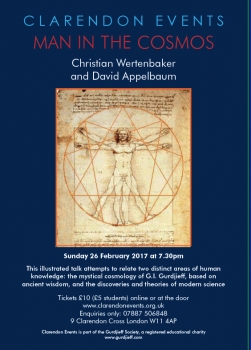
Sunday 26 February 2017 at 7.30pm
This illustrated talk attempts to relate two distinct areas of human knowledge: the mystical cosmology of G.I.Gurdjieff, based on ancient wisdom, and the discoveries and theories of modern science.
Long convinced of the validity of both approaches to the understanding of the nature of the universe and humanity’s place in it, Dr. Wertenbaker has spent many years investigating their possible connections. The resulting ideas provide a fresh look at the age-old question of the relationship between the inner world of consciousness and the outer world of phenomena.
Christian Wertenbaker has been a practicing physician for forty years, with post graduate training in opthalmology, neurorology, neuro-opthalmology and neurophysiology. He is also a long time member of the Gurdjieff Foundation, and a musician.
David Appelbaum is a professor at State University of New York at New Paltz and is the author of several books on spiritual philosophy. Graduate of Harvard, Professor Appelbaum is also a former senior editor of Parabola Magazine (The Search for Meaning), purveyor of local geography and lover of mountain hikes. He is the current publisher of Codhill Press.
THE JOY OF J S BACH
A Christmas Concert by
The Clarendon Ensemble (International Gurdjieff Society Musicians)
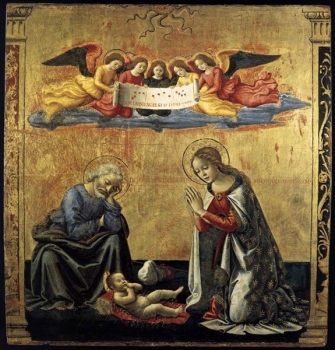
Sunday 11 December 2016 at 7:30pm
We are happy to present a seasonal celebration of some of the most sublime music of J.S. Bach. The programme will include:
1. Sinfonia G major (Pastorale) from the Christmas Oratorio BWV 248 arranged.
2. Schliesse mein Herz (Hold thou for ever this blessing in wonder) for Alto, oboe solo and continuo from the Christmas Oratorio BWV 248 for the Third day of Christmas
3. Flute sonatano 5 in E minor BWV 1034 Adagio and Allegro
4. Cello suite no1 G major. Prelude
5. Flosst mein Heiland (Say my Saviour, tell me rightly..) Soprano, oboe solo, cello/organ continuo from the Christmas Oratorio BWV 248 for New Year's Day
6. Trio sonata in C major BWV 1037 for Flute, Oboe and Continuo. Adagio, Alla breve, Largo, Gigue
7. Weh der Seele (Woe to the Soul which no longer recognises guilt) from Cantata BWV 102 for the Tenth Sunday after Trinity Alto, oboe solo, cello, organ continuo.
8. Herr du siehst (Lord with Thee our works awaken less regard than faith unshaken) from BWV 9 for 6th Sunday after Trinity. For Soprano and Alto, oboe, flute, and organ
9. Mein Gläubiges Herze (My Heart ever Faithful) Soprano and cello solo, flute and continuo.
10. Chorale (Jesu Joy of Man's desiring) BWV 147
Monica Marubayashi, soprano, Régine Orlik de Romémont, alto, Daniel Neukom, flute, Herbert Lashner, oboe,
Dietrich Bethge, Sarah Bethge, cellos, Ben Pearce-Higgins, organ and harpsichord.
About 75 minutes
ELECTRICITY: A CALL TO CONSCIOUSNESS
JEREMY NAYDLER
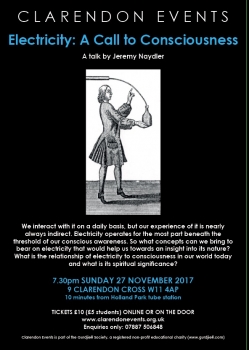
Sunday 27 November 2016 at 7.30pm
We interact with it on a daily bases but our experience of it is nearly always indirect. Electricity operates for the most part beneath the threshold of our consciousness. So what concepts can we bring to bear on electricity that would help us towards an insight into its nature? What is the relationship of electricity to consciousness in our world today and what is its spiritual significance?
MEETINGS WITH REMARKABLE MEN 3pm
A FILM BY PETER BROOK
Sunday 23 October 2016 at 3.00pm
A newly remastered Director’s cut of the film that tells the story of Gurdjieff’s early life and his search for hidden knowledge – based on the book with the same title
(Running time 90 minutes)
MEETINGS WITH REMARKABLE MEN 7.30pm
A FILM BY PETER BROOK
Sunday 23 October 2016 at 7.30pm
A newly remastered Director’s cut of the film that tells the story of Gurdjieff’s early life and his search for hidden knowledge – based on the book with the same title
(Running time 90 minutes)
THE NATURE OF MIND
A TALK
LAMA CHIME RINPOCHE
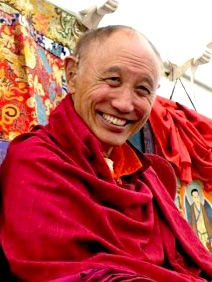
Sunday 3 July 2016 at 7.30pm
Lama Chime Rinpoche was born near Jyekundo, Kham, in East Tibet and was brought up as a Lama in Benchen Monastery. He was introduced to the essential nature of his own mind by Khenpo Gangshar. With the Chinese invasion he was forced to leave his homeland and together with a group of people escaped to Bhutan undergoing great hardships on the way
Lama Chime Rinpoche was one of the first reincarnate lamas to come to the West, and has lived in England since 1965. Coming from a medieval Tibetan world to the highly mechanised world of the west he felt the need to understand English ways. He worked for a long time in the British library, married and had three children. Meanwhile he set up his Tibetan Buddhist Centre Marpa House. This work is carried on now by a body of his students who have gone deeply into Vajrayana Buddhism. One of Lama Chime’s aims is to bring Buddhism into the life of people and not just into a monastic setting. Rinpoche has his own unique way of teaching in which there is a great deal of attentive listening as well as humour.
GEORGIAN SINGING
Church chants, ritual folk and healing songs
NANA MZHAVANADZE
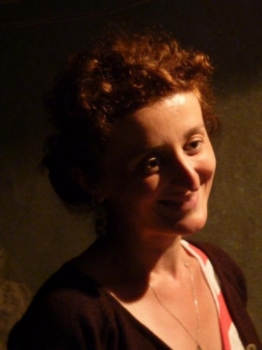
Friday 17 June 2016 at 6.30 to 9.30 pm
This is a rare opportunity to work with our much loved singing teacher and true bearer of an oral tradition handed down from her grandparents. An ethnomusicologist, Nana has worked with our choirs in Paris and Holland and led expeditions with our groups in Georgia. The programme includes ancient church chants, ritual folk and healing songs, new sounds, taught gently by ear, not to be missed!
Enquiries 07887 506 848
PLEASE NOTE THAT THIS EVENT IS ON FRIDAY, NOT SUNDAY AS USUALLY.
THE TIGHTROPE (repeat screening)
A documentary film by SIMON BROOK
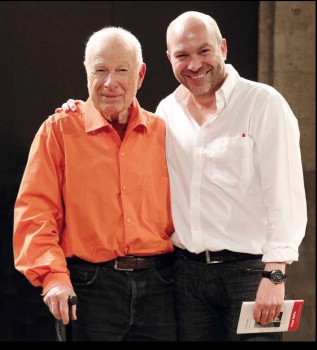
Sunday 20 March 2016 at 7.30pm
THE TIGHTROPE REVEALS, FOR THE FIRST TIME, THE EXPERIMENTAL WAY THAT SIMON'S FATHER PETER BROOK WORKS WITH ACTORS. IT SHOWS A SIMPLE, YET DIFFICULT, EXERCISE THAT IS ESSENTIALLY A METAPHOR TAKING US STRAIGHT INTO OUR OWN LIVES, WHERE THE NEED FOR BALANCE, LOST AND FOUND, IS PRESENT AT EVERY MOMENT.
The film runs for 90 mintes.
Enquiries only (no reservations) 07887 506848
Tickets also will be available on the door if not sold out in advance
For the latest information on ticket availability please call 07887 506848
PLEASE NOTE: If you have chosen delayed payment from PayPal we are not notified of your booking until we receive payment. In this case kindly alert us via email so that we can confirm and acknowledge your booking Please also check that the email address provided is current, otherwse we are unable to respond.
WE LOOK FORWARD TO WELCOMING YOU
THE TIGHTROPE SORRY THIS EVENT IS NOW FULLY BOOKED
A documentary film by SIMON BROOK
To be introduced by PETER BROOK
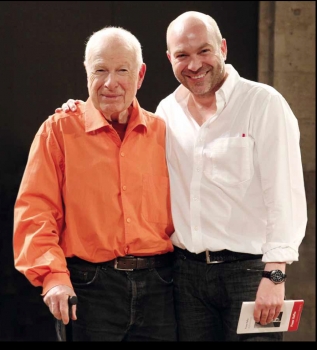
Sunday 14 February 2016 at 7.30pm
THE TIGHTROPE REVEALS, FOR THE FIRST TIME, THE EXPERIMENTAL WAY THAT SIMON'S FATHER PETER BROOK WORKS WITH ACTORS. IT SHOWS A SIMPLE, YET DIFFICULT, EXERCISE THAT IS ESSENTIALLY A METAPHOR TAKING US STRAIGHT INTO OUR OWN LIVES, WHERE THE NEED FOR BALANCE, LOST AND FOUND, IS PRESENT AT EVERY MOMENT.
MESSIAH PART 1 with HALLELUIA CHORUS
A CHAMBER PERFORMANCE by CLARENDON MUSIC ENSEMBLE
Leader Clare Hoffman, directed by Ben Pearce-Higgins
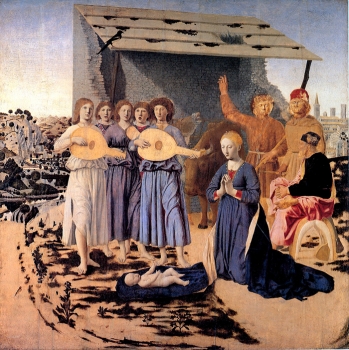
Sunday 13 December 2015 at 7.30pm
ADVENT AND NATIVITY with HALLELUIA CHORUS
JOIN US IN A CELEBRATION OF THE TRUE SPIRIT OF CHRISTMAS
With Gurdjieff Society musicians and singers, soloists and chorus from London music colleges.
CLARENDON MUSIC ENSEMBLE
ORCHESTRA
Violin 1: Clare Hoffman C/bass: David Glanville
Violin 2: Liz Partridge Oboe: Herbert Lashner
Viola: Hilary Glanville Harpsichord/organ: Christopher Bevan
Cello: Dietrich Bethge Director: Ben Pearce-Higgins
SOPRANOS
Monica Marubayash (solo) was born in Brazil and a singer at the Municipal Theatre of Sao Paulo beforeshe was awarded a scholarship to study at the Royal Academy of Music in London. She performed as a soloist with the Armonica Tributo Orchestra, Irish Baroque Orchestra Chamber Soloists, and at the Early Music Festival, Edinburgh Fringe and Chester Music Festival. She also taught on summer courses in Brazil and Austria.
Florence Clempson currently is studying at the Royal Academy of Music in London.
Jane Metcalfe is an experienced choir trainer and singing teacher who currently is running an advanced course at the City Lit evening institute in London. She has numerous videos online with the City Lit Singers.
Eleanor Sanderson-Nash, is a soprano from East Sussex. She is studying currently at the Royal College of Music and previously at the Royal Northern College of Music where she graduated with a First Class Honours degree this year. Eleanor has enjoyed playing various roles in opera and musical theatre and future plans include playing Despina (Cosi fan Tutte) in RCM's January opera scenes performances, as well as numerous performances with the two groups she sings with regularly: Celeste and The Four Sopranos.
ALTOS
Mathew Paine (solo) is a counter tenor from Bristol and currently studying at the Royal Academy of Music. He performs as a soloist with local choirs.
Anna Jeffers (solo) Welsh born mezzo soprano Anna began her studies at the Birmingham Conservatoire where she played many operatic roles and was a major prize winner. Highlights of 2015 include joining Buxton Festival Opera where Anna will be singing the small roles of Madeleine, Laitiere and Madame de Cresson in Charpentier's Louise, returning to Wexford Festival Opera in the Autumn to sing the role Hansel in Hansel and Gretel and joining Opera North's extra chorus for their Winter season.
Sophie Dicks (solo) began her operatic training at the Royal Northern College of Music. She is now studying at the Royal College of Music. Sophie has worked with Buxton Festival Opera and Opera Holland Park. Her future engagements include a performance of Elgar's The Music Makers where she will be singing the mezzo soprano solo with Keele Philharmonic Orchestra.
TENORS
Edward Bonner (solo) read music at Cambridge, studied singing at TrinityLaban, and now splits his time between working as a teacher at Tonbridge Grammar School and at his local bookshop in Sevenoaks, where he lives. He is a keen sportsman and plays cricket and football regularly.
James Rhoads was a choral scholar at both Wells and Worcester cathedrals, and currently is at King’s College London. He is a member of the famous 16 choral group.
Kieran White is studying a Masters degree at the Royal Academy of Music. He is a Bach Scholar and Soloist. Kieran is formerly a chorister at Wells Cathedral who has also sung in the Chorus at Dorset Opera and the RCS. Future engagements include the role of Renaud in Armide by Lully for Woodhouse Opera.
BASS
Harry Thatcher (solo) is a graduate from The Royal College of Music and a Better Brenner Opera scholar. He has studied with Andrew Watts, Peter Savidge and currently Russell Smythe. Harry's recent roles included 'Death' (BYO - Savitri), 'Frank' (Cover) (RCMIOS - Die Fledermaus). Harry was a Somerset song prizefinalist in 2015. This coming summer he will perform two roles for Grange Park Opera.
James Geidt was a chorister at St John’s College School, Cambridge, The King’s School, Canterbury and Oxford Brookes University where he read Music whilst also singing in the choir of New College. James appears as a soloist on recordings of Britten Choral works and also features regularly as a soloist for the BBC National Chorus of Wales.
Christian Adolph holds a Bachelor of Music in vocal performance and pedagogy from the Hochschule für Musik Karlsruhe. He has also studied at the Institut für Musiktheater in Karlsruhe, as well as at the Royal College of Music in London. Christian is also known for his international work as a professional chorister and has recorded for Deutsche Grammophon.
ALL VOICES (with experience) NEEDED FOR HALLELUIA CHORUS.
PLEASE CONTACT DIRECTOR on 07887 506 848
RIVER OF INDIAN STORIES Hindu Epics and folktales
Storytelling in Performance: Including tales from Mahabharata and Ramayana
DR. VAYU NAIDU
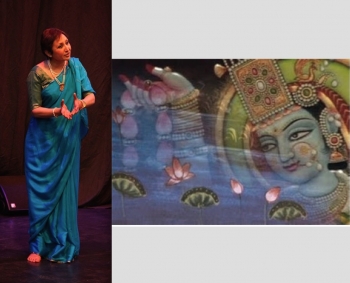
Sunday 22 November 2015 at 7.30pm
Indian rivers symbolise the vicissitudes of life. All are named, worshipped and bear witness to daily life and significant rites of passage by immersion.
To Vayu Naidu a river is a story in full flow. A story is a narrative thread connecting diverse aspects of life. With her Storytelling she will enliven your understanding of the myth of River Ganga, why trees flower, and more. She will create a swift current of stories from the Hindu epics and folk tales. The intention is to transport you across Time and Space: Kalam and Sthanam while heightening your awareness of the reality around us.
Her Storytelling in English is inspired by Rasa - a prism of emotional states of the human condition.
RIVER OF INDIAN STORIES flows across cultures and returns you to your own, refreshed.
Dr. Vayu Naidu has worked and studied with Indic oral performance traditions in Britain, and internationally for the last 25 years. Arts Council England funded Vayu Naidu Storytelling Theatre Company from 2002-2012. Her plays for BBC Radio Drama were produced and directed by Vanessa Whitburn. Her work with composer Judith Weir has toured India and Britain with BCMG (Birmingham Contemporary Music Group). Her AHRC Post Doctoral Fellowship shaped a methodology to include Performative aspects ranging from Museum Collections and cross disciplinary Performing arts to working with mental health, migration, and multicultural education as well as in Prisons
PROGRAMME for 22 November 2015
Indic oral Storytelling is composed and performed with the power, and aim, of darsana or visualisation. Training with the Baul, Gayani, and Hari Katha opened this ability to see and tell. The key that unlocks visualisation or inspired imagination in the listener, for me, is Rasa – emotive intelligence. Love, Anger, Fear, Contempt, Pity, Heroism, Wonder, Peace are categories of universal emotions - with tributaries; the way rivers flow into the sea. In this evening’s programme Rasa is evoked through each story I’ve selected and composed for the contemporary listener. Each story is a journey along the flowing river of words and rasa into your deeper self where imagination meets vision, and is immersed in unity. Then, your life is refreshed.
MOTHER AS I SAW HER:
Why do we tell and listen to stories? The birth of the god who removes obstacles by uncluttering our minds to bring peace. What is Devi?
Source: invocation inspired
GANGA: RIVER OF DEATH, RIVER OF LIFE:
We can never understand the course of life’s events, until we stop to listen to the stories that happened before we began.
Source: Mahabharata
SNAKE STORY:
The fear and fascination of snakes, also creates a festival when they are worshipped to gain an understanding of other lives, other selves.
Source: Gujerati elders from East Africa at Belgrave Road, Leicester, and
AK Ramanujan
LISTENING:
What happens when you really listen to stories from Ramayana.
Source: Pantheon Folk tales, Sita’s Ascent
WHEN VISHNU LOVES:
A story of remembering.
Source: Sati; Sister Nivedita.
THE ART OF MEDITATION
An illustrated talk
RICHARD TEMPLE
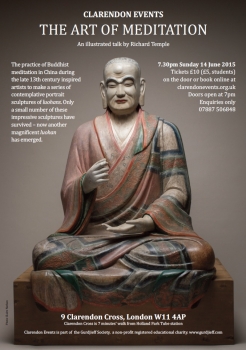
Sunday 14 June 2015 at 7.30pm
The practice of Buddhist meditation in China during the late 13th century inspired artists to make a series of contemplative portrait sculptures of luohans, who were commanded by Buddha to await the coming of Maitreya and to act as teachers and guardians. Only a small number of these impressive sculptures have survived in museums around the world. Now another magnificent luohan has emerged.
Tickets also will be available at the door on the night.
Doors open 7pm
The event will last approximately 90 minutes
Enquiries only 07887 506848
J S BACH AND THE MUSIC OF THE COSMOS
A talk with musical examples from the piano
LAURENCE ROSENTHAL
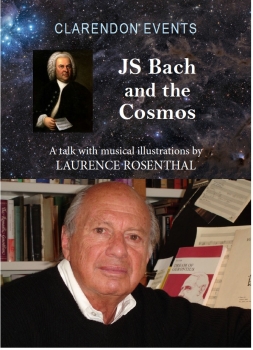
Sunday 10 May 2015 at 7.30pm
SORRY THIS EVENT IS SOLD OUT!
Laurence Rosenthal will explore with
extraordinary and moving examples at the piano, in a non technical way, how Johann Sebastian Bach translated the mysteries of the universe into musical sounds. He will portray Bach as the culmination and summit of the age of faith in western civilisation, at the same time looking forward into the age of enlightenment, the modern era, with astounding vision and prescience.
Laurence Rosenthal is an American composer conductor and pianist. He studied with the famous Nadia Boulanger in Paris, has composed film scores (with Oscar nominations), chamber music, and recently an opera based on the theme of the legend of Gilgamesh. He is best known in Gurdjieff circles as the composer and arranger of Thomas de Hartmann’s music for Peter Brook’s film of Gurdjieff’s book entitled ‘Meeting with Remarkable Men’. Laurence Rosenthal is known also as one of the editors of the complete Gurdjieff/de Hartmann piano works published by Schott editions in four volumes, and as a pianist who has promoted this music tirelessly world wide and on disc. Laurence Rosenthal is based in San Francisco and is engaged in researching the meaning behind the ideas of Gurdjieff’s teaching.
PLEASE NOTE DUE TO LIMITED NUMBER OF SEATS THIS EVENTS CAN BE BOOKED ONLY IN ADVANCE. TICKETS WILL NOT BE SOLD AT THE DOOR.
For enquiries only 07887 506848
THE GRAND INQUISITOR
A dramatised reading from the Dostoyevsky novel The Brothers Karamazov
BRUCE MYERS
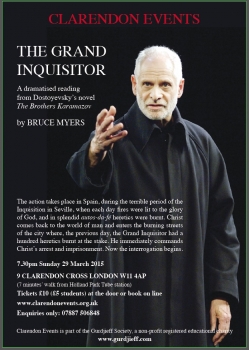
Sunday 29 March 2015 at 7.30pm
The action takes place in Spain, during the terrible period of the Inquisition in Seville, when each day fires were lit to the glory of God, and in splendid autos-da-fé heretics were burnt. Christ comes back to the world of man and enters the burning streets of the city where, the previous day, the Grand Inquisitor had a hundred heretics burnt at the stake. He immediately commands Christ’s arrest and imprisonment. Now the interrogation begins.
This reading, a well know passage from The Brothers Karamazov by Fyodor Dostoyevsky, is adapted for the theatre by Marie Hélène Estienne. As a staged production, starring Bruce Myers and directed by Peter Brook, it toured widely to great acclaim. Later it reverted to a script in hand version, which is how it began and how it will be performed at Clarendon Events.
Mainly active in the theatre, Bruce Myers has appeared in numerous productions by Peter Brook, and has collaborated with him in his experimental theatre company in Paris, Les Bouffes du Nord, since it began in 1970. Bruce also played one of the Seekers of Truth in Meetings with Remarkable Men, Peter Brook’s 1979 film adaptation of Gurdjieff’s book about his early life.
Bruce, who lives in Paris, is a director as well as an actor. He returned recently from Athens where he directed Les Bonnes by Jean Genet at the National Theatre of Greece. He also teaches theatre in Italy.
Enquiries only: 07887 506848
INTO GREAT SILENCE (Le Grand Silence)
A DOCUMENTARY FILM by Philip Gröning
Showing the daily life of the monks living in the Grande Chartreuse monastery
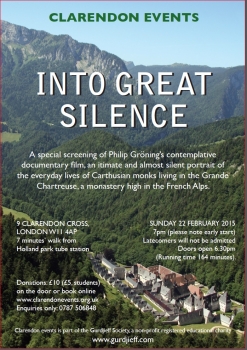
Sunday 22 February 2015 at 7.00PM
A special screening of Philip Gröning’s contemplative documentary film, an intimate and almost silent portrait of the everyday lives of Carthusian monks living in the Grande Chartreuse a monastery high in the French Alps.
PLEASE NOTE THE EARLIER START TIME. LATECOMERS CANNOT BE ADMITTED.
Running time 126 minutes
Doors open 6.30pm
Enquiries only 07887 506848
A CONCERT OF ARMENIAN FOLK SONGS
HIDDEN SOUNDS
ARAM AND VIRGINIA KEROVPYAN AND FAMILY
Sunday 7 December 2014 at 7.30pm
SOURCES and CONNECTIONS
An illustrated talk
PAUL KORALEK
Sunday 19 October 2014 at 7.30pm
Paul Koralek CBE, RA, RIBA will review some of the ideas, images and experiences that have shaped his work as an architect. His buildings, produced in partnership with his friends and colleagues Peter Ahrends and Richard Burton can be seen in many parts of the UK, the Republic of Ireland as well as abroad. He is a founding partner of ABK Architects and co-chairman of the Gurdjieff Society of which he is a lifelong member.
WIND WATER FIRE An illustrated talk
Finding traces of the Law of Three in Kabbalistic and early Christian imagery
JIM BARLOW
Sunday 22 June 2014 at 7.30pm
The Rev’d Jim Barlow currently serves as a priest in the Oxford Diocese of the Church of England. He has conducted extensive and original research into early Jewish and Christian mystical traditions for the last 30 years. Although this included a brief tenure as a Research Fellow in Mysticism and Religious Experience at Oxford, he left to continue pursuing a more experiential approach. Much of his work is concerned with aspects of embodiment in traditional ascetic and contemplative practice.
SONGS and SACRED HYMNS
A concert by members of the Gurdjieff Society
NORMAN HIGGINS piano MONICA MARUBAYASHI soprano MICHAEL GRIFFITH piano
Sunday 18 May 2014 at 7.30pm
Songs for voice and piano composed by Norman Higgins.
Sacred Hymns and other works from Music for Piano by Gurdjieff/de Hartmann.
Tickets also may be purchased at the door.
Enquiries only 07887 506 848
18 May 2014
P R O G R A M M E: Part 1
SONGS arranged and composed by NORMAN HIGGINS
Mônica Marubayashi Soprano Norman Higgins Piano
TRADITIONAL MUSIC of St. MARY’S NORTHOLT PARISH CHURCH
1) Psalm 84 ‘O how amiable’ & Psalm 42 ‘Like as the Hart’
2) John 8:12 ‘Jesus said, I am the light of the world’
3) Psalm 122:6 ‘Pray for the peace of Jerusalem’
NEW SONGS (First performances)
4) Far, far away
5) Lullaby
MOON SONGS
6) Raindrops
7) Moon in Circles - Interlude
8) How silent is the night
9) In the deep of the night
10) Prayer of St Francis of Assisi from Canticle of the Sun
Norman Higgins has worked with many dancers including Margot Fonteyn and Tamara Karasavina,
He leads an innovative company offering music, stories, scripts and ideas for all forms of dance, from the youngest children’s imaginative dance to an adult company performing ballets and shows on stage.
The educational dance input is provided by Jean Higgins, a teacher of dance, producer and choreographer of numerous original stage productions,
Norman’s music is also used in schools and colleges, nurseries, Montessori Schools, hospitals, physiotherapy departments, convents, prisons, drama groups, gymnastic clubs etc
Mônica Marubayashi was born in Brazil and was a singer at the Municipal Theatre of Sao Paulo before she was awarded a scholarship to study at the Royal Academy of Music in London. She has performed as a soloist with the Armonica Tributo Orchestra, Irish Baroque Orchestra Chamber Soloists, and at festivals such as the Early Music Festival, Edinburgh Fringe, and Chester Music Festival. She has taught on summer courses in Brazil and Austria.
St. Mary’s is a 13th-century Anglican parish church in Northolt, London where there has been music and worship for over 700 years. It is one of London's smallest churches, with a nave measuring only 44 feet (13 m) by 25 feet (7.6 m). The church was built around 1290 and was expanded over the following centuries, with the chancel being added in 1521, the spired bell tower being added in the 16th century and the west end gallery being built in 1703. The internal beams are original and the bells date from the 17th century. Despite its small size, the church has played an important role in the ecclesiastical life of London; from the 13th century to 1873 its Rector served as the Bishop of London. It was the first Anglican parish to appoint a female Rector.
P R O G R A M M E: Part 2
SACRED HYMNS and other pieces
from ‘MUSIC for the PIANO’ by GURDJIEFF/de HARTMANN
Michael Griffith piano
Michael Griffith, our ‘guest pianist’, is from the Sydney Australia Gurdjieff Group, where he has been playing the Gurdjieff Movements and concert music for many years. Michael worked closely with the pianist Helen Adie until her death in 1989. Helen was a direct pupil of both Gurdjieff and Thomas de Hartmann and was responsible for the Movements in Sydney. Michael is an associate professor of literature at the Australian Catholic University in Sydney and currently is on long service leave in England. Whilst here he is lecturing on his speciality, William Blake.
1) Book I no.17 Kurd Shepherd Melody
2) Book I no.8 Tibetan Melody Book
3) Book III no.37 Meditation
4) Book III no.50 The Resurrection of Christ
Norman Higgins piano
5) Book I no.10 Lento - Quasi recitativo
6) Book II no.14 Dervish Dance
7) Book III no. 8 For organ in F minor
8) Book IV no.18 Tibetan Movement
9) Book IV no.17 Tibetan Dance
10) Book IV no.16 Tibetan Dance
11) Book IV no.10 Essene Hymn
12) Book IV no.2 Hymn No. 2
13) Book III no.5 Dolcissimo in G major
14) Book III no. 36 Hymn to Our Endless Creator
‘MUSIC for the PIANO’ by GURDJIEFF/de HARTMANN is available in 4 volumes from Schott Music Publishing
GEORGE IVANOVITCH GURDJIEFF
First film in the series 'The Seekers of Truth'
Directed by Jean-Claude Lubtchansky
Sunday 23 March 2014 at 7.30pm
This is the first in a series of three films entitled The Seekers of Truth dedicated to G.I. Gurdjieff and his work. This film shows his unending search from early years in the Caucasus, to his last days in Paris, where he died in 1949. He was accompanied throughout by those who later carried on the teaching which continues today.
Doors open at 7pm
The film runs for 72 minutes
Information only 07887 506 848
THE JOURNEY OF THE SOUL IN DANTE'S DIVINE COMEDY
An illustrated talk focussing on the profound spiritual and psychological teachings of Dante's epic poem
JEREMY NAYDLER
Sunday 23 February 2014 at 7.30pm
Beginning in confusion and despair, Dante describes his descent into the dark depths of Hell, followed by his arduous climb up the mountain of Purgatory until, led by his guide Beatrice, he finally traverses the planetary spheres to the highest reaches of Heaven. There he experiences the culminating vision of the divine source of light and love. In this illustrated talk, Jeremy Naydler will give an overview of the Divine Comedy, including some of the profound psychological and spiritual teachings that it contains.
Jeremy Naydler, Ph.D., is a philosopher who specializes in the religious life of ancient cultures. He is a Fellow of the Temenos Academy and author of Temple of the Cosmos, Shamanic Wisdom in the Pyramid Texts, The Future of the Ancient World, and Goethe on Science. He lives in Oxford, England.
THOMAS DE HARTMANN
Friend of Kandinsky and the avant-garde
An evening with ELAN SICROFF organised by the Temple Gallery
Sunday 12 May 2013 at 7.30pm
RESERVATIONS ONLY THROUGH info@templegallery.com
Thomas de Hartmann (1885-1956) graduated from the St Petersburg Conservatory when he was 18. Three years later his ballet The Scarlet Flower, starring Nijinsky, was performed before the Tsar. From 1908-12 he was part of the avant-garde world that included his lifelong friend Kandinsky. Then in 1916 he met George Ivanovitch Gurdjieff and followed him to Paris where, for the next 13 years, he dedicated himself wholeheartedly to the collaboration that produced the music for the Movements and the ‘Gurdjieff-de Hartmann’ piano compositions. After de Hartmann left Gurdjieff in 1929 he spent his remaining years composing in the classical idiom: solo piano, chamber music, concerti, four symphonies, the opera Esther, choral works and ballet. During the 1940s he composed 50 film scores under a pseudonym. He renewed contact with a number of important musicians, among them Pablo Casals and Alexander Schneider of the Budapest Quartet, and with the help of these friends he could give concerts again. But the success of his early years never returned. He died of a heart attack days before he was to appear in New York’s Town Hall for a solo recital of his works.
Elan Sicroff trained as a classical pianist at the Juilliard School and the Oberlin Conservatory. From 1973-5 he attended the International Academy for Continuous Education in Sherborne, Gloucestershire, run by J. G. Bennett, a leading exponent of Gurdjieff’s teaching. Bennett introduced Elan to Mme de Hartmann, wife of the composer, and from 1975 until 1979
he studied with her and performed de Hartmann’s works. Elan has given numerous recitals of this music in concert halls and universities in the US, Canada, and Europe. In this presentation Elan will concentrate on de Hartmann’s little-known work before and after the time he spent with Gurdjieff.
SHARED MIND
Am I a cell phone or a mouth organ?
A talk by PETER BROOK
Sunday 28 April 2013 at 7.30pm
PayPal is now closed. Some reservations may still be possible, please enquire.
SATHANAO
A Concert by
The Women’s Choir from TBILISI GEORGIA
Sunday 13 May 2012 at 7.30pm
GEORGIA, neither Asian nor European, is essentially South Caucasian, and unlike any neighbouring region. Its people have maintained a spirit and passion for life which is at the heart of its truly priceless musical heritage, so designated by UNESCO in its first assessment of the “masterpieces of the oral and intangible heritage of humanityâ€.
Embracing Christianity in the fourth century, after Armenia, Georgian church chanting developed through mutual interaction with folk song, sometimes dating from pre Christian times, into a complex three part polyphonic system free from outside influence and unique in the history of world music. The chants and ritual folk songs have been passed by aural transmission through families, reaching us today through their devotion and sacrifice.
For the transmission of this precious material Sathanao members are professionally trained to research, collect, perform and teach. They have worked together since their student days to preserve the integrity of the church and folk songs by singing them in their own natural way, from the heart. This performance by Sathanao at Clarendon Events on their first tour in the UK is not to be missed.
PRESS RELEASE
SATHANAO
Women’s choir from TBILISI GEORGIA
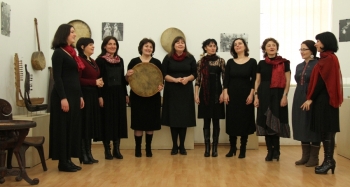
Sunday 13 May 2012 at 7.30pm
GEORGIA, is a unique country neither Asian nor European, but essentially South Caucasian, unlike any neighbouring region but deeply influenced by all adjacent cultures through centuries of conquest. The people of Georgia have maintained a spirit and passion for life which is at the heart of their truly priceless cultural heritage, so designated by UNESCO in its first assessment of the “masterpieces of the oral and intangible heritage of humanityâ€. The terrain, ‘God’s garden’ according to legend, a wild landscape, with remote inaccessible mountains and fertile valleys, the origin of the holy science of wine making, a variety of cultural regions each with its own traditions and languages, music and singing are essential to the survival of this strong and vibrant people. The second country, after Armenia, to embrace Christianity in the fourth century, Georgian church chanting developed through interaction with folk singing, itself sometimes dating from pre Christian times, into a complex three part polyphonic system without any outside influence and unique in the history of world music. These chants and ritual folk songs were passed by aural transmission through families within and outside church circles, reaching us today through the sacrifice and devotion of people who gave their lives in some cases to preserve their tradition. It is no exaggeration to say that Sathanao (meaning the precious thing which is Georgian polyphony) is a part of this sacred process.
The members of the group are old friends who met as students at the Conservatoire of Music in Tbilisi. Together they began research into the ancient heritage of Georgian church chants, inspired by Malkhaz Erkvanidze who, with the Anchiskhati choir, was working to revive the many chants which had come close to extinction during the Soviet regime. Sathanao studied chants which had been preserved in transcriptions made in the early 19th century and help reintroduce them for use in everyday liturgical practice. For several years, Sathanao sang chants each week during traditional services in the famous church of Jvaris Mama in Tbilisi. The choir we know today was re-formed in 2005 after a break made necessary by the demands of family life. Sathano’s unique repertoire covers not only old church chants but also village music (mainly women’s repertoire, with some well-chosen songs more traditionally sung by men) and urban songs. Sathanao do not to take the songs out of context and for this reason do not simply mimic the old village singers, who nevertheless remain their inspiration, but aim to preserve the integrity of the songs by singing them in their own natural way, from the heart. Sathanao has toured Europe, taken part in international festivals and broadcast on BBC radio.
THE SEVEN DEADLY SINS
A talk by
Dr. Jeremy Naydler
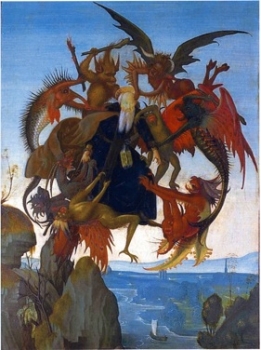
Sunday 18 March 2012 at 7.30pm
Pre-Christian in origin, the tradition concerning the Seven Deadly Sins was originally an esoteric teaching associated with the arduous inner discipline of cleansing the soul from the negative aspects of the seven planetary energies, so that it might return to its celestial home. Today the tradition can be understood as providing a guide-map to becoming conscious of our dark and, therefore, very hard to see, inner compulsions. Becoming aware of them, we may experience the peculiar suffering that accompanies the realisation of how flawed we are, but we may also awaken to a more authentic moral and spiritual centre within ourselves.
Dr Jeremy Naydler holds a PhD in Theology and Religious Studies, and is the author of three books on religious life in antiquity, most recently The Future of the Ancient World: Essays on the History of Consciousness (2009).
A CELEBRATION OF GEORGIAN MUSIC
A singing workshop and lecture by MALKHAZ ERKVANIDZE, and concert by ENSEMBLE SAKHIOBA
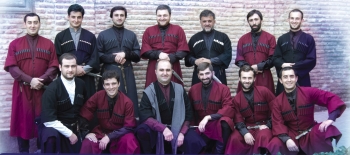
Sunday 27 November 2011
Musicologist, researcher, teacher and a world authority on Georgian polyphony, Malkhaz Erkvanidze is well known for his gentle patience with his pupils, regardless of their musical experience. He follows his workshop with an illustrated talk on Georgian polyphonic forms and tuning systems.
Ensemble Sakhioba is a group of twelve exceptional young musicians who bring the ancient sounds of church and folk songs from the Caucasus with deeply felt spiritual resonance and dazzling allure. The ensemble is led by master musician Malkhaz Erkvanidze.
NEW POEMS FROM THE POETRY CIRCLE
THE POETRY CIRCLE
Sunday 3 July 2011 at 7:30pm
The Poets Circle has been in vigorous life for eight years, has run several Workshops that have helped new poets very successfully to discover their talents and find that inner voice which has been heard in the Circle's three previous Recitals and in its printed books.
All are welcome!
LIFE LESSONS FROM THE BHAGAVAD GITA
A lecture by RAVI RAVINDRA
Sunday 26 June 2011 at 7:30pm
Ravi Ravindra was born in India where he received his early education. He studied as an undergraduate in Canada where later he made his home. Currently Ravi is Professor Emeritus at Dalhousie University, in Halifax, Nova Scotia, where for many years he was a professor in the Departments of Comparative Religion, Philosophy, and Physics. He has been a Member of the Institute of Advanced Study in Princeton, a Fellow of the Indian Institute of Advanced Study in Shimla, and the Founding Director of the Threshold Award for Integrative Knowledge. Ravi has served on the Board of Judges for the Templeton Prize for Progress in Religion and has written six books on the teachings of Krishnamurti, Gurdjieff, Yoga and Zen, as well as the mystical teachings of the Indian and Christian traditions.
MYSTICAL MUSIC FROM ASIA
THE LONDON UYGHUR ENSEMBLE
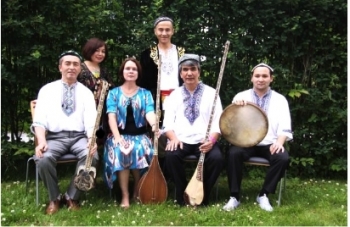
Sunday 5 June 2011
The UK’s first locally-based group (www.uyghurensemble.co.uk), in connection with SOAS, perform the music and dance of the Central Asian Uyghurs. The Uyghurs live mainly in the large desert and mountain region of northwest China now known as Xinjiang. Rahima Mahmut’s thrilling vocals are accompanied by an ensemble of long-necked lutes, spike fiddle and frame drum. This easternmost example of the maqÄm traditions of the Islamic world, with its limping rhythms and ecstatic poetry, is deeply imbued with the Sufi ethos.
PLANETARY PERSPECTIVE ON THE ENVIRONMENTAL CRISIS
DR. CHARLES LANGMUIR
Sunday 15 May 2011
DR. CHARLES LANGMUIR, head of Harvard Department of Earth Sciences, will continue his theme of planetary exploration, 'PLANETARY PERSPECTIVE ON THE ENVIRONMENTAL CRISIS', following on from his talk for Clarendon Events last November.
Charles 'Charlie' Langmuir has discovered hydrothermal sites in three ocean basins, and recently co-led the first investigation of the Arctic Ocean ridge system. He has carved a distinguished career in the international science arena investigating many aspects of the solid earth geochemical cycle. He is a Fellow of the American Academy of Arts and Sciences, the Geochemical Society, and the American Geophysical Union, from which he received the N. L. Bowen Award in 1996. He received the Holmes Medal of the European Union of Geosciences in 2003. Charlie received his B.A. from Harvard University and Ph.D. from the State University of New York at Stony Brook, where his dissertation research focused on major and trace elements in basalts. He has been at Harvard since 2002, after 20 years at Columbia University's Lamont- Doherty Earth Observatory. Charlie has explored the seafloor through some 20 research cruises over the last two decades.
THE KNIGHTS OF GEORGIAN CHANT
A film directed by NANA JANELIDZE
Sunday 10 April 2011
A special screening of Nana Janelidze's beautiful and moving film about the survival of Georgian Chant against all odds as a result of great sacrifices by the heroes of the story. This copy of the film was given to us by Nana at last year's Georgian Film Festival in London, and has been seen by very few people here. It will be a special occasion, followed by a reception and informal Georgian singing.
CHRISTMAS CONCERT
SATHANAO WOMENS' CHOIR from TBILISI
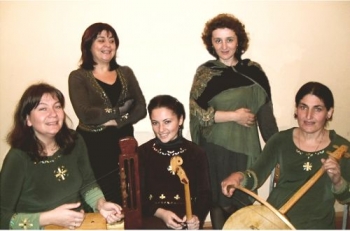
Sunday 12 December 2010
by SATHANAO, Georgian women’s choir from Tbilisi, specially brought to London by Clarendon Events, with THE CLARENDON CHAMBER CHOIR, and guest appearance by TABUNI London Georgian women's choir.
POLYPHONY MUSIC FOR CHRISTMAS. The programme will include sacred Georgian church chants, English polyphonic sacred music from the 16th century, Georgian Alilos, traditionally sung from house to house at Christmas time, and other traditional Georgian songs.
GLOBAL CLIMATE CHANGE: WHAT IS KNOWN, AND WHAT IS NOT KNOWN
A talk by ROBERT REINSTEIN
Sunday 14 November 2010
The earth has a natural greenhouse effect, without which it would be unliveable for our form of life. In addition, in the past century or so humans have been adding to that effect by various activities, principally the burning of fossil fuels (coal, oil and natural gas). But how much of what we see as climate change (longer-term shifts in weather patterns) is due to humans and how much to natural variability that has been occurring for millions of years? And what might be a sensible policy response in light of remaining uncertainty about the relative causes of climate change?
Robert Reinstein was trained in mathematics, physics and economics, and has over the past 45 years been a teacher, writer, editor, energy economist, trade negotiator and diplomat. He was chief US climate negotiator for the UN Framework Convention on Climate Change (Rio Treaty) in 1991-92, and chaired at different times two out of the three working groups of the Intergovernmental Panel on Climate Change (IPCC), which received half of the 2007 Nobel Peace Prize. Since 1996 he has headed his own consulting firm, with offices in Washington, Helsinki and Brussels, and was also visiting professor of environmental management at the Free University, Amsterdam, in 1993.
TECHNOLOGY AND THE HUMAN SPIRIT
A talk by DR JEREMY NAYDLER
Sunday 7 November 2010
Philosophers have traditionally viewed the possession of reason as what makes human beings distinct from animals. Now the development of computer technologies, which function strictly in accordance with the rules of logic, challenges us to consider the ways in which humans are distinct from machines. What, if anything, enables us to rise above the purely mechanical? How can we awaken authentic spiritual experience and equip ourselves to meet the ever-growing menace of the inhuman in the modern world?
Jeremy Naydler, Ph.D., is a philosopher who specializes in the religious life of ancient cultures. He is a Fellow of the Temenos Academy and author of Temple of the Cosmos, Shamanic Wisdom in the Pyramid Texts, The Future of the Ancient World, and Goethe on Science. He lives in Oxford, England. Dr Naydler gave a Clarendon Event last year on SACRED ART OF GARDENING
PIANO MUSIC
A concert by MUSICIANS OF THE GURDJIEFF SOCIETY
Sunday 27 June 2010
Joseph Haydn:
Piano Sonate no 49 in Eb major
J.S.Bach:
Prelude and fugue in Eb minor no 8 book 1
Well Tempered Clavier
Gurdjieff/de Hartmann:
The Initiation of the Priestess
Dervish Dances
Said Chant and Dance
Alleluia
Easter Hymn and Holy Night Procession
IN SEARCH OF THE SACRED
A concert by 'ENSEMBLE RÉSONANCE'
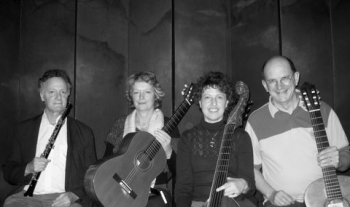
Sunday 23 May 2010
Herbert Lashner - oboe
Christian Chanel - guitar
Marie Chanel - guitar
Nima ben David - viola da gamba
ENSEMBLE RÉSONANCE was created as a result of the fortuitous meeting of five musicians that occurred at an international music conference held near San Francisco California in the summer of 2000. The name of the group comes from a search that we share in common as musicians and as human beings.
Programme
I.
Johann-Sebastian BACH after Alessandro MARCELLO
Concerto in D minor BWV 974 for oboe and strings **
Andante spicatto - Adagio - Presto
Karl-Friedrich ABEL
Prelude in D minor for viola da gamba
Gabriel FAURÉ
Pavane op. 50 for two guitars **
Erik SATIE
Three Gnossiennes **
guitar - oboe and guitar
** Transcriptions & Arrangements by Christian Chanel
Intermission
II.
GURDJIEFF / de HARTMANN
Kurd Shepherd's Dance
Asian Song
Armenian Song
Sayyid Chant and Dance
The Struggle of the Magicians (Two fragments)
Persian Dervish
Sayyid Chant and Dance
Sayyid Dance (for Mr. Gurdjieff's Wife)
Dance
Long ago in Mikhailov
Sayyid Chant and Dance
Sayyid Dance
Prayer for Mercy
Prayer
Meditation
MASTER AND PUPIL
A recital of music by HAYDN and BEETHOVEN for piano and string quartet
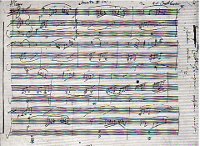
Sunday 22 November 2009
Haydn: Piano Sonata no 49 in Eb major
BENJAMIN PEARCE-HIGGINS
Haydn: String Quartet opus 76 no 4 'The Sunrise' 1st movement
Beethoven: Introduction to his life, and opus 130 analysis
Beethoven: String Quartet opus 130 in Bb & Opus 133 'Grosse Fugue'
HOFFMAN QUARTET
Beethoven's late quartets were all he wrote during the last three years of his life. Ill, deaf, poor, and alone, they were an outlet for his anguish and distress. This one is considered the happiest, with bursts of 'youthful' inspiration defining a radiant masterpiece.
EARTH AND HUMAN : A PLANETARY PERSPECTIVE
An illustrated talk by CHARLES LANGMUIR - Higgins Professor of Geochemistry at Harvard University
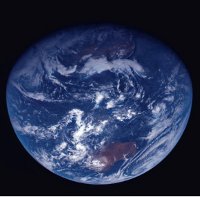
Sunday 18 October 2009
"Human degradation of the environment has the potential to stall an ongoing process of planetary evolution and even to rewind the evolutionary clock, to leave the planet habitable only by the bacteria that dominated billions of years of Earth's history. Planetary evolution is seen as a series of steps: there's no guarantee that a planet will proceed from one to the next. Each step represents a moment of both crisis and opportunity. So far, the Earth has surmounted each step, while other planets, such as Mars, which may have once had microscopic life, failed to cross the evolutionary hurdle where life is sustained and becomes abundant. Whether the planet takes the next step or not may depend on us. If we recognize humanity is an integral part of the planet and begin working for a healthy Earth, then planetary evolution could move forward. The story of the Earth is our story. We are intimately connected to the Earth in every fibre of our being, in every breath we take. We're inseparable from the Earth." (As reported in the Harvard Gazette)
IN BETWEEN TWO WORLDS
New poems by the POETRY CIRCLE
Sunday 5 July 2009
Roy Ashwell
Andrew Brenner
John Haggarty
Anne Humphreys
Phyllis King
Maria Lockhart
Robin Marchesi
Meredith Ricketts
Tilo Ulbricht
and poems by Sam Copley and by Philip Cook
This is the Fourth Recital of their poems by the Poets' Circle.
Texts of all the poems read and more will be for sale.
SACRED SOUNDS:TRACING THE ROOTS OF INDIAN MUSIC
An illustrated talk by JAMEELA SIDDIQI
Sunday 21 June 2009
Jameela Siddiqi is a novelist, journalist and broadcaster who came to Britain as a refugee from Uganda in 1972. She studied English and History at Makerere University Kampala, and at the London School of Economics. She has worked as a television journalist, broadcaster and writer since 1976. She won a Sony Gold award for her series "Songs of the Sufi Mystics" on BBC World Service Radio (1997) and was presenter of the acclaimed Radio 3 series "Nights of the Goddess" (2000) which featured music from Mumbai. She has compiled numerous albums and written liner notes for Indian classical, devotional film and folk music CDs. She is a regular contributor and reviewer for 'Songlines' and has authored chapters on Indian music for both 'Rough Guides to World Music' and a forthcoming Cambridge University volume. She has also written for a CD-Rom on the origins and evolution of Indian Classical music. Her first novel "The Feast of the Nine Virgins" was published by Bogle L'Ouverture in London, (2001). She has just completed a second novel, "Bombay Gardens.â€.
GARDENING AS SACRED ART
A Lecture by DR. JEREMY NAYDLER
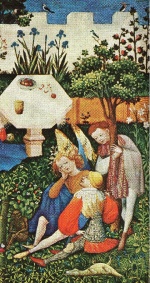
Saturday 28 March 2009
Since the seventeenth century, Nature has been perceived less as a sacred presence that surrounds us than as a physical resource to be exploited by us. The change in gardening styles from the Medieval to the Early Modern period reflected this development. During the twentieth century, however, the new artist-gardeners saw the intensification of Nature’s inherent beauty as their deeper goal. This talk will explore the implications for the future